
NEET
- Exam
- NEET
- Subject
- Botany
- Chapter
- Anatomy of Flowering Plants
NEET · Botany · Anatomy of Flowering Plants
Identify X and select the correct statement.
Identify X and select the correct statement.
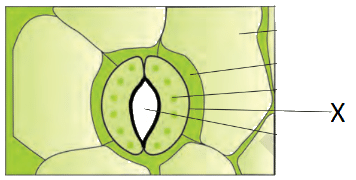
Options
- ASubsidiary cells - A few guard cells, in the vicinity of the epidermal cells become specialized in their shape and size and are known as subsidiary cells
- BEpidermal cells - Epidermal cells are sclerenchymatous with a small amount of cytoplasm lining the cell wall and a large vacuole
- CGuard cells - The guard cells possess chloroplasts and regulate the opening and closing of stomata
- DNone of the above
Correct answer
C. Guard cells - The guard cells possess chloroplasts and regulate the opening and closing of stomata
Step-by-step solution
Epidermal cells are parenchymatous with a small amount of cytoplasm lining the cell wall and a large vacuole. The outside of the epidermis is often covered with a waxy thick layer called the cuticle which prevents the loss of water. Cuticle is absent in roots. Stomata are structures present in the epidermis of leaves. Stomata regulate the process of transpiration and gaseous exchange. Each stoma is composed of two bean shaped cells known as guard cells which enclose stomatal pore. In grasses, the guard cells are dumb-bell shaped. The outer walls of guard cells (away from the stomatal pore) are thin and the inner walls (towards the stomatal pore) are highly thickened. The guard cells possess chloroplasts and regulate the opening and closing of stomata. Sometimes, a few epidermal cells, in the vicinity of the guard cells become specialised in their shape and size and are known as subsidiary cells.