Quantrex Quantrex AcademyJEE · NEET · NDA PYQs with solutions Open app
NEET
Exam
NEET
Subject
Botany
Chapter
Anatomy of Flowering Plants

NEET · Botany · Anatomy of Flowering Plants

Label the diagram as A, B, C, D, and E respectively.

Label the diagram as A, B, C, D, and E respectively.
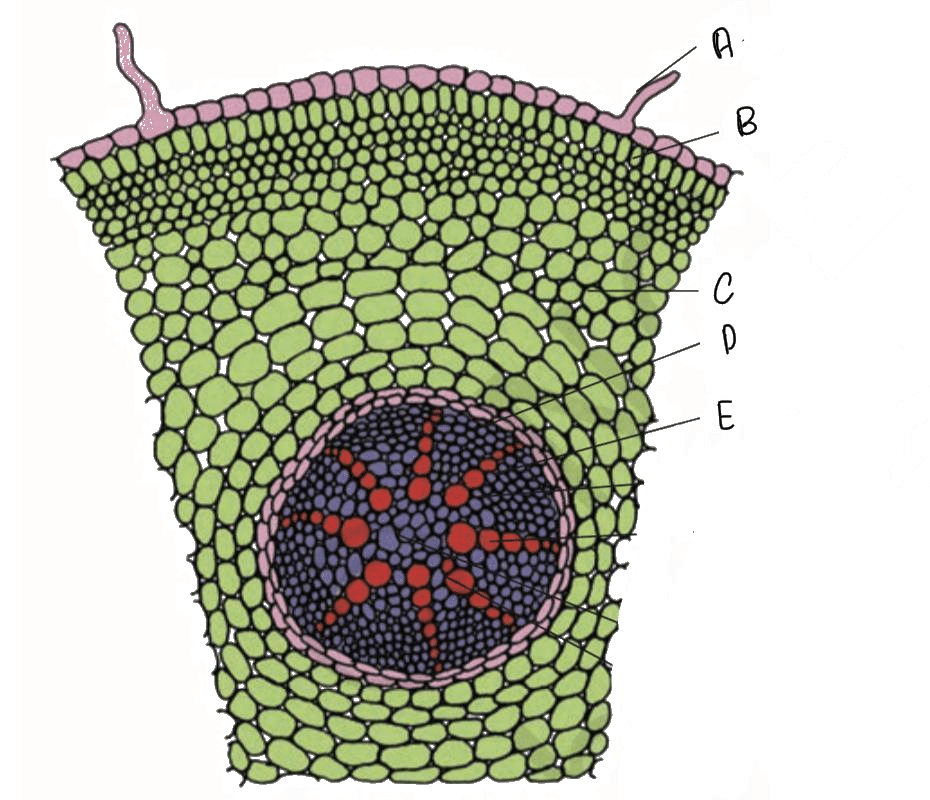
Options

  1. ATrichomes, Epidermis, Cortex, Endodermis, Pericycle
  2. BTrichomes, Hypodermis, Cortex, Endodermis, Pericycle
  3. CRoot hair, Epidermis, Cortex, Endodermis, Pericycle
  4. DRoot hair, Hypodermis, Cortex, Endodermis, Pericycle

Correct answer

C. Root hair, Epidermis, Cortex, Endodermis, Pericycle

Step-by-step solution

A, B, C, D, and E respectively are Root hair, Epidermis, Cortex, Endodermis, and Pericycle. The diagram represents the transverse section of monocot root.
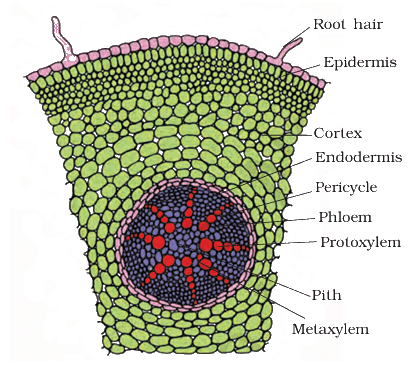
Label the diagram as A, B, C, D, and E respectively.
Practice Anatomy of Flowering Plants on Quantrex Academy →

More from Anatomy of Flowering Plants

The main function of bulliform cells in grasses is : NEET 2026Match List I with List II : List I List II A. Conjunctive tissue I. Specialised cells in… NEET 2026Find the statement that is NOT correct with regard to the structure of monocot stem. NEET 2025Which of the following simple tissues are commonly found in the fruit walls of nuts and… NEET 2024Given below are two statements: Statement I: In a dicotyledonous leaf, the adaxial… NEET 2024Given below are two statements: Statement I : Parenchyma is living but collenchyma is… NEET 2024Bulliform cells are responsible for NEET 2024Formation of interfascicular cambium from fully developed parenchyma cells is an example… NEET 2024 Full Anatomy of Flowering Plants list All NEET PYQs