
JEE Advanced 2019Paper 2
- Exam
- JEE Advanced
- Year
- 2019
- Paper
- Paper 2
- Subject
- Mathematics
- Chapter
- Application of Derivatives
JEE Advanced 2019 · Paper 2 · Mathematics · Application of Derivatives
Let f(x) = sin x ^ 2 , x > 0 . Let x _ 1 Then which of the...
Let
Let be all the points of local maximum of and be all the points of local minimum of
Then which of the following options is/are correct?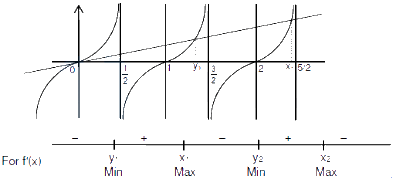
Let be all the points of local maximum of and be all the points of local minimum of
Then which of the following options is/are correct?
Options
- A for every
- B
- C\left(2n, 2n + \dfrac{1}{2}\right)n
- D for every
Correct answer
A. for every
Step-by-step solution
\left(x\right) = \dfrac{2xcos \pix\left(\dfrac{\pix}{2} - tan \pix\right)}{{x}^{4}}⇒{f}^{'}\left(x\right) = 0\begin{cases}⇒ cos \pix = 0 & or\dfrac{\pix}{2} = tan \pix\end{cases}\begin{cases}∵ cos \pix \ne 0 & & \left\{∵ tan \pi xwillnotbedefined\right\}\end{cases}∴tan
Case
\left(i\right)x \in at point
and at
at
hence from equation (i)
in goes from positive to negative
hence is maxima
Similarly … are point of maxima and all lies in
Case
In
\left(ii\right){P}_{1}, x \in \left(1, \dfrac{3}{2}\right)\cos \left(\pix\right) < 0{P}_{1}^{+}, \tan \left(\pix\right) > \dfrac{\pix}{2}{P}_{1}^{-}, \tan \left(\pix\right) < \dfrac{\pix}{2}x \in \left(2n + 1, 2n + \dfrac{3}{2}\right), {f}^{'}\left(x\right)⇒{y}_{1}: 1 < {y}_{1} < \dfrac{3}{2}{y}_{2}: 3 < {y}_{2} < \dfrac{7}{2}{y}_{3}: 5 < {y}_{3} < \dfrac{11}{2}{x}_{1}: 2 < {x}_{1} < \dfrac{5}{2}{x}_{2}: 4 < {x}_{2} < \dfrac{9}{2}{x}_{3}: 6 < {x}_{3} < \dfrac{13}{2}{x}_{n} > {y}_{n}
now,
Similarly,
…(b)
\left|{x}_{n} - {y}_{n}\right| > 1⇒ {y}_{2} > {x}_{1}\tan \left(\pi{y}_{2}\right) > \tan \left(\pi{x}_{1}\right)\tan \left(\pi{y}_{2}\right) > \tan \left(\pi + \pi{x}_{1}\right) ⇒ {y}_{2} > {x}_{1} + 1⇒ {y}_{n + 1} > {x}_{n} + 1{x}_{n} 1{x}_{n + 1} - {x}_{n} = \left({x}_{n + 1} - {y}_{n + 1}\right) + \left({y}_{n + 1} - {x}_{n}\right){x}_{n + 1} - {x}_{n} > 2
Case
\left(i\right)x \in at point
and at
at
hence from equation (i)
in goes from positive to negative
hence is maxima
Similarly … are point of maxima and all lies in
Case
In
\left(ii\right){P}_{1}, x \in \left(1, \dfrac{3}{2}\right)\cos \left(\pix\right) < 0{P}_{1}^{+}, \tan \left(\pix\right) > \dfrac{\pix}{2}{P}_{1}^{-}, \tan \left(\pix\right) < \dfrac{\pix}{2}x \in \left(2n + 1, 2n + \dfrac{3}{2}\right), {f}^{'}\left(x\right)⇒{y}_{1}: 1 < {y}_{1} < \dfrac{3}{2}{y}_{2}: 3 < {y}_{2} < \dfrac{7}{2}{y}_{3}: 5 < {y}_{3} < \dfrac{11}{2}{x}_{1}: 2 < {x}_{1} < \dfrac{5}{2}{x}_{2}: 4 < {x}_{2} < \dfrac{9}{2}{x}_{3}: 6 < {x}_{3} < \dfrac{13}{2}{x}_{n} > {y}_{n}
now,
Similarly,
…(b)
\left|{x}_{n} - {y}_{n}\right| > 1⇒ {y}_{2} > {x}_{1}\tan \left(\pi{y}_{2}\right) > \tan \left(\pi{x}_{1}\right)\tan \left(\pi{y}_{2}\right) > \tan \left(\pi + \pi{x}_{1}\right) ⇒ {y}_{2} > {x}_{1} + 1⇒ {y}_{n + 1} > {x}_{n} + 1{x}_{n} 1{x}_{n + 1} - {x}_{n} = \left({x}_{n + 1} - {y}_{n + 1}\right) + \left({y}_{n + 1} - {x}_{n}\right){x}_{n + 1} - {x}_{n} > 2