Quantrex Quantrex AcademyJEE · NEET · NDA PYQs with solutions Open app
JEE Advanced 2017Paper 2
Exam
JEE Advanced
Year
2017
Paper
Paper 2
Subject
Physics
Chapter
Alternating Current

JEE Advanced 2017 · Paper 2 · Physics · Alternating Current

The instantaneous voltages at three terminals marked X, Y and Z are...

The instantaneous voltages at three terminals marked X,YandX, Y andZaregivenby<br/>are given by<br />{V}_{X} = {V}_{0}sin \omegat<br/><br />{V}_{Y} = {V}_{0}sin (\omegat+2π3)\left(\omegat + \dfrac{2\pi}{3}\right) and
VZ=V0sin⁡(\omegat+4π3).{V}_{Z} = {V}_{0}\sin \left(\omegat + \dfrac{4\pi}{3}\right) .
An ideal voltmeter is configured to read rms value of the potential difference between its terminals. It is connected between points XX and YY and then between YY and ZZ . The reading(s) of the voltmeter will beThe instantaneous voltages at three terminals marked X, Y and Z are given by V _ X = V _ 0 sin V _ Y = V _ 0 sin ( +The instantaneous voltages at three terminals marked X, Y and Z are given by V _ X = V _ 0 sin V _ Y = V _ 0 sin ( +
Options

  1. AVXYrms=V0{V}_{XY}^{rms} = {V}_{0}
  2. BVYZrms=V012{V}_{YZ}^{rms} = {V}_{0}\sqrt{\dfrac{1}{2}}
  3. CIndependent of the choice of the terminals
  4. DVXYrms=V032{V}_{XY}^{rms} = {V}_{0}\sqrt{\dfrac{3}{2}}

Correct answer

C. Independent of the choice of the terminals

Step-by-step solution

Potential difference between XandY=VX−VYXandY = {V}_{X} - {V}_{Y}

Potential difference between YandZ=VY−VZYandZ = {V}_{Y} - {V}_{Z}

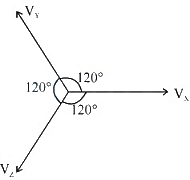
Phasor of the voltages:

The instantaneous voltages at three terminals marked X, Y and Z are given by V _ X = V _ 0 sin V _ Y = V _ 0 sin ( +

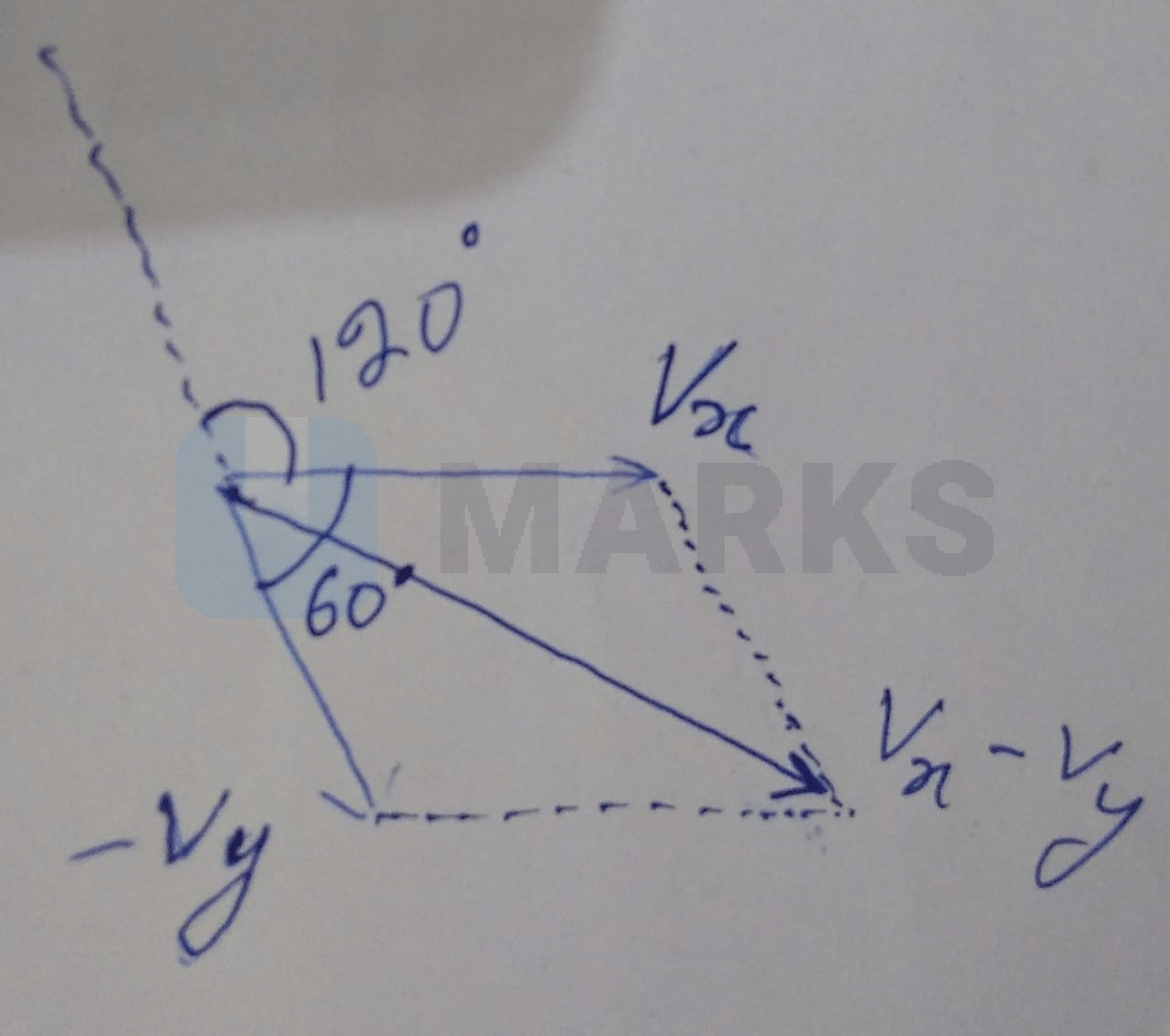
From phasor diagram the peak value of Vx−Vy{V}_{x} - {V}_{y} can be calculated from parallelogram law

The instantaneous voltages at three terminals marked X, Y and Z are given by V _ X = V _ 0 sin V _ Y = V _ 0 sin ( +

(Vx−Vy)peak=VX2+VY2+2VXVYcos⁡(60)=V02+V02+2V0V0×12=3V0{\left({V}_{x} - {V}_{y}\right)}_{peak} = \sqrt{{V}_{X}^{2} + {V}_{Y}^{2} + 2{V}_{X}{V}_{Y}\cos \left(60\right)} = \sqrt{{V}_{0}^{2} + {V}_{0}^{2} + 2{V}_{0}{V}_{0} \times \dfrac{1}{2}} = \sqrt{3}{V}_{0}

∴(VX−VY)peak=3V0∴ {\left({V}_{X} - {V}_{Y}\right)}_{peak} = \sqrt{3}{V}_{0}

(Vx−Vy)rms=VXYrms=3V02{\left({V}_{x} - {V}_{y}\right)}_{rms} = {V}_{XY}^{rms} = \dfrac{\sqrt{3}{V}_{0}}{\sqrt{2}}

Similarly (Vy−Vz)rms=VXYrms=3V02{\left({V}_{y} - {V}_{z}\right)}_{rms} = {V}_{XY}^{rms} = \dfrac{\sqrt{3}{V}_{0}}{\sqrt{2}}

Practice Alternating Current on Quantrex Academy →

More from Alternating Current

Consider a circuit consisting of a capacitor of capacitance C and a coil with N turns per… JEE Advanced 2026A LCR series circuit driven with E_ rms = 90 V at frequency f_d = 30 Hz has resistance R… JEE Main 2026A series LCR circuit with R = 20\ Ω , L = 1.6 H and C = 40\ is connected to a variable… JEE Main 2026An a.c. source of angular frequency ω is connected across a resistor R and a capacitor C… JEE Main 2026An inductor of 10 mH, capacitor of 0.1\ μ F and a resistor of 100\ Ω are connected in… JEE Main 2026The figure given below shows an LCR series circuit with two switches S_1 and S_2 . When… JEE Main 2026An inductor stores 16 J of magnetic field energy and dissipates 32 W of thermal energy… JEE Main 2026The electric current in the circuit is given as i=i_ o (t / T) . The r.m.s current for… JEE Main 2026 Full Alternating Current list All JEE Advanced PYQs