
JEE Advanced 2026Paper 2
- Exam
- JEE Advanced
- Year
- 2026
- Paper
- Paper 2
- Subject
- Physics
- Chapter
- Mechanical Properties of Fluids
JEE Advanced 2026 · Paper 2 · Physics · Mechanical Properties of Fluids
Passage: A container of height 2 m, length 2 m and breadth 1 m is...
Passage: A container of height m, length m and breadth m is made of insulating vertical walls and two large area horizontal metal plates ( and ) which extend far beyond the vertical walls in all directions. The container is partitioned into two equal chambers with a thin insulating vertical wall. The partition wall contains a small hole of cross-sectional area cm near its bottom edge. Initially the hole is closed and the left chamber of the container is completely filled with a liquid of dielectric constant and the right chamber is empty (). At time , the hole is opened and the liquid flows from the left chamber to the right chamber. In both the chambers, the space above the liquid has and is maintained at atmospheric pressure. The schematic of the container at a time is shown in the figure.
[Given: acceleration due to gravity is ms.]
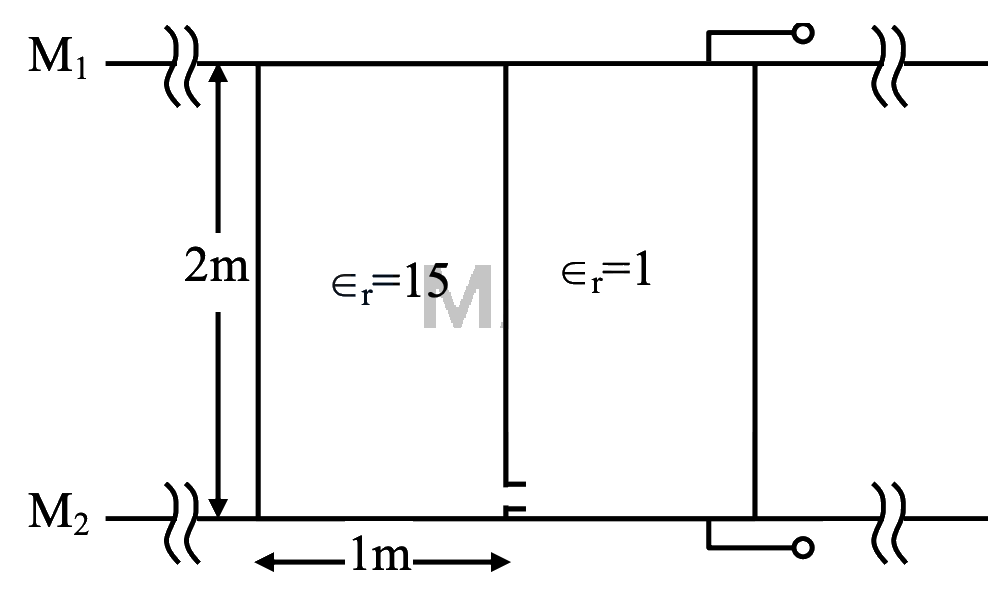
Question: The height (in m) of the liquid in left chamber at s is:
[Given: acceleration due to gravity is ms.]
Question: The height (in m) of the liquid in left chamber at s is:
Correct answer
1.25
Step-by-step solution
Let be the cross-sectional area of each chamber and be the cross-sectional area of the hole.
From the given dimensions, the area of each chamber is .
The area of the hole is .
Let and be the heights of the liquid in the left and right chambers at time , respectively.
By conservation of volume, , where m is the initial height of the liquid in the left chamber.
The velocity of efflux through the hole is given by Torricelli's law:
The rate of flow of the liquid is:
Substitute into the equation:
Let . Then , which gives .
The differential equation becomes:
Integrating both sides from to s. At , m, so m.
Squaring both sides, we get:
Since , we have:
Answer: