
JEE Advanced 2026Paper 2
- Exam
- JEE Advanced
- Year
- 2026
- Paper
- Paper 2
- Subject
- Physics
- Chapter
- Wave Optics
JEE Advanced 2026 · Paper 2 · Physics · Wave Optics
As shown in the figure, a ray AB of unpolarized light enters from...
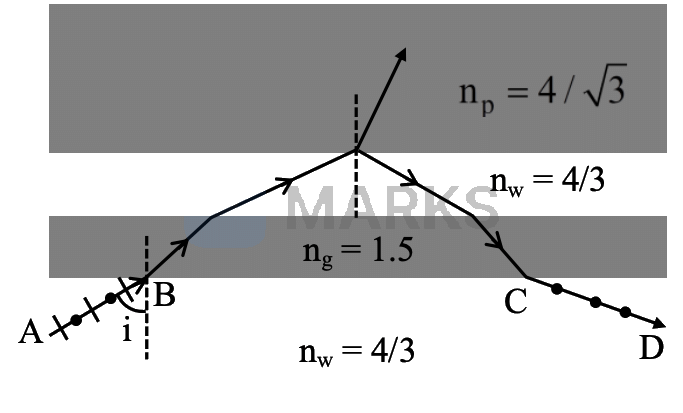
As shown in the figure, a ray of unpolarized light enters from water of refractive index into a medium of refractive index after passing through a glass plate of refractive index and a layer of water. At a particular incident angle the reflected ray is polarized in the direction as shown in the figure. The value of (in degrees) is:
Correct answer
0
Step-by-step solution
Let the angle of incidence at the first interface (water to glass) be .
By applying Snell's law at the successive parallel interfaces, we can find the angle of incidence at the interface where the reflection occurs (water to medium ).
For the first interface (water to glass):
For the second interface (glass to water):
From the above two equations, we get:
Thus, the angle of incidence at the third interface (water to medium ) is also .
The problem states that the reflected ray is completely polarized with its electric field perpendicular to the plane of incidence (indicated by the dots on ray ). This complete polarization upon reflection occurs when the light is incident at Brewster's angle .
According to Brewster's law for the interface between water and medium :
Since the angle of incidence at this interface is , we have . Substituting the given refractive indices:
Therefore, the angle of incidence is:
Answer: