Quantrex Quantrex AcademyJEE · NEET · NDA PYQs with solutions Open app
Concepts Of Physics MCQ Edition [Volume 1]
Exam
Concepts Of Physics MCQ Edition [Volume 1]
Subject
Physics
Chapter
Photometry

Concepts Of Physics MCQ Edition [Volume 1] · Physics · Photometry

As illustrated in the figure, a small diffused plane source S is...

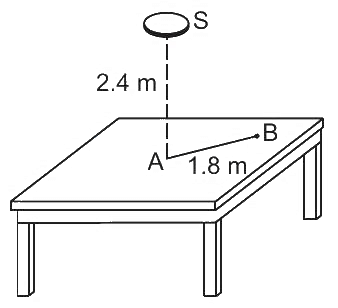
As illustrated in the figure, a small diffused plane source SS is positioned 2.4 m2.4 \text{ m} above a horizontal table-top, such that its plane is parallel to the table-top. At point AA, which lies directly beneath the source, the illuminance is 25 lux25 \text{ lux}. Determine the illuminance at a point BB on the table, situated 1.8 m1.8 \text{ m} away from AA.
As illustrated in the figure, a small diffused plane source S is positioned 2.4 m above a horizontal table-top, such

Options

  1. A12.8 lux12.8 \text{ lux}
  2. B10.24 lux10.24 \text{ lux}
  3. C16.0 lux16.0 \text{ lux}
  4. D3.24 lux3.24 \text{ lux}

Correct answer

B. 10.24 lux10.24 \text{ lux}

Step-by-step solution

For a small diffused plane source, the luminous intensity in a direction making an angle θ\theta with the normal is given by Lambert's cosine law:

I(θ)=I0cos⁡θI(\theta) = I_0 \cos \theta

The illuminance EE at a point on a surface is given by:

E=I(θ)r2cos⁡ϕE = \dfrac{I(\theta)}{r^2} \cos \phi

where rr is the distance from the source to the point, and ϕ\phi is the angle of incidence. Since the source plane is parallel to the table-top, the angle of emission θ\theta is equal to the angle of incidence ϕ\phi. Thus:

E=I0cos⁡2θr2E = \dfrac{I_0 \cos^2 \theta}{r^2}

At point AA, the point is directly beneath the source, so θ=0∘\theta = 0^\circ and rA=2.4 mr_A = 2.4 \text{ m}.

EA=I0(2.4)2=25⇒I0=25×5.76=144 cdE_A = \dfrac{I_0}{(2.4)^2} = 25 \Rightarrow I_0 = 25 \times 5.76 = 144 \text{ cd}

For point BB, the distance from the source is:

rB=(2.4)2+(1.8)2=5.76+3.24=9.00=3.0 mr_B = \sqrt{(2.4)^2 + (1.8)^2} = \sqrt{5.76 + 3.24} = \sqrt{9.00} = 3.0 \text{ m}

The angle θ\theta for point BB is given by:

cos⁡θ=2.43.0=0.8\cos \theta = \dfrac{2.4}{3.0} = 0.8

The illuminance at BB is:

EB=I0cos⁡2θrB2=144×(0.8)2(3.0)2=144×0.649=16×0.64=10.24 luxE_B = \dfrac{I_0 \cos^2 \theta}{r_B^2} = \dfrac{144 \times (0.8)^2}{(3.0)^2} = \dfrac{144 \times 0.64}{9} = 16 \times 0.64 = 10.24 \text{ lux}
Practice Photometry on Quantrex Academy →

More from Photometry

Calculate the radiant flux of a source if it emits 45 joules of energy over a period of… Concepts Of Physics MCQ Edition [Volume 1]When exposed to a 10 W source for 12 s , a photographic plate records sufficiently… Concepts Of Physics MCQ Edition [Volume 1]Based on the relative luminosity curve shown in the figure, determine the relative… Concepts Of Physics MCQ Edition [Volume 1]Based on the relative luminosity curve shown in the figure, determine the relative… Concepts Of Physics MCQ Edition [Volume 1]Based on the relative luminosity curve shown in the figure, determine the relative… Concepts Of Physics MCQ Edition [Volume 1]The relative luminosity for a wavelength of 600 nm is 0.6 . Determine the radiant flux at… Concepts Of Physics MCQ Edition [Volume 1]Based on the relative luminosity curve shown in the figure, determine the relative… Concepts Of Physics MCQ Edition [Volume 1]A monochromatic source of 1 W produces a luminous flux of 450 lumen . Determine the… Concepts Of Physics MCQ Edition [Volume 1] Full Photometry list All Concepts Of Physics MCQ Edition [Volume 1] PYQs