
Concepts Of Physics MCQ Edition [Volume 2]
- Exam
- Concepts Of Physics MCQ Edition [Volume 2]
- Subject
- Physics
- Chapter
- Electric Current in Conductors
Concepts Of Physics MCQ Edition [Volume 2] · Physics · Electric Current in Conductors
Determine the equivalent resistance between the points a and b for...
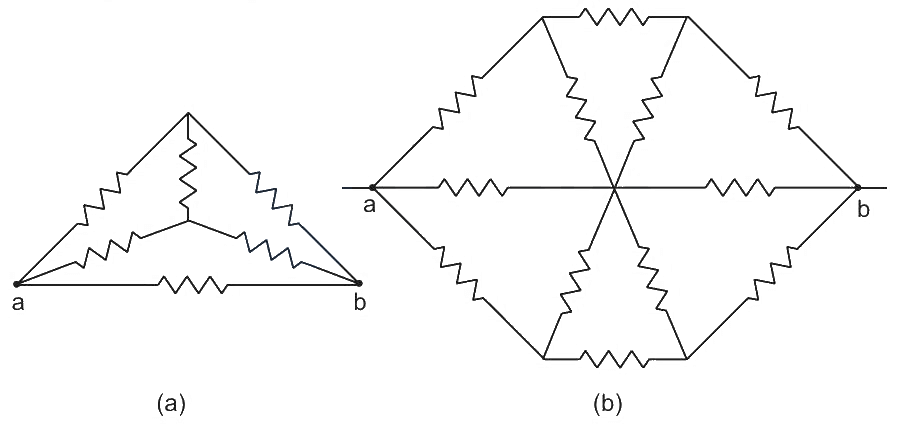
Determine the equivalent resistance between the points and for the circuits displayed in the figure. Every resistor has a resistance .
Options
- A(a) , (b)
- B(a) , (b)
- C(a) , (b)
- D(a) , (b)
Correct answer
A. (a) , (b)
Step-by-step solution
For the first circuit, let the vertices of the triangle be , , and (top), and the central node be . The circuit is symmetric about the vertical axis passing through and . When a potential difference is applied across and , the nodes and will be at the same potential. Since , no current flows through the resistor connecting and , so it can be removed from the circuit. The simplified circuit consists of three parallel branches between and . The first branch is the direct resistor between and with resistance . The second branch is the series combination of resistors and , with resistance . The third branch is the series combination of resistors and , with resistance . The equivalent resistance is given by , which gives .
For the second circuit, the structure is a hexagon with a central node . Let the nodes on the perimeter be in clockwise order. The circuit is symmetric about the vertical axis passing through and the midpoints of resistors and . If a voltage is applied between and such that and , the potential along the vertical axis of symmetry is zero. The circuit can be split into two identical halves (left and right) in series. The left half consists of nodes and the grounded points (node and the midpoints of and ). Node is connected to ground via resistor (resistance ) and the left half of resistor (resistance ). These two are in parallel, so the equivalent resistance from to ground is . Similarly, the equivalent resistance from node to ground is . From node , there are three parallel paths to ground. The first path is through to ground with resistance . The second path is through to ground with resistance . The third path is directly through to ground with resistance . The equivalent resistance of the left half, , is given by . This gives . The total equivalent resistance between and is .
Answer: (a) , (b)