
Concepts Of Physics MCQ Edition [Volume 2]
- Exam
- Concepts Of Physics MCQ Edition [Volume 2]
- Subject
- Physics
- Chapter
- Electric Current in Conductors
Concepts Of Physics MCQ Edition [Volume 2] · Physics · Electric Current in Conductors
Determine the potential difference between points A and B , and...
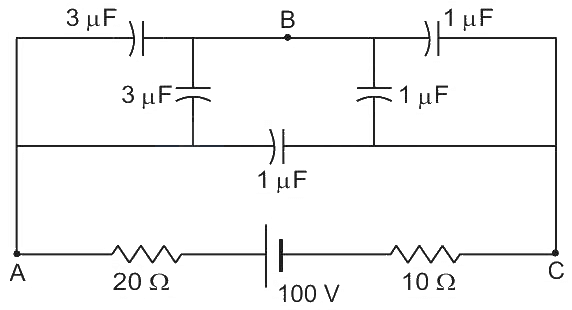
Determine the potential difference between points and , and between points and , for the circuit shown in the figure in steady state.
Options
- A and
- B and
- C and
- D and
Correct answer
A. and
Step-by-step solution
In steady state, the capacitors are fully charged and act as open circuits. Therefore, no direct current flows through the circuit ().
Since the current is zero, there is no voltage drop across the and resistors. The potential difference across the capacitor network, between points A and C, is equal to the electromotive force of the battery:
Let us analyze the connections of the capacitors in the network. The left vertical wire is entirely at potential , and the right vertical wire is entirely at potential .
The top capacitor is connected between node A and node B. The middle horizontal wire is connected to the left vertical wire (node A). The vertical capacitor connects this middle wire to node B. Thus, both capacitors are connected in parallel between nodes A and B. Their equivalent capacitance is:
Similarly, the top capacitor is connected between node B and node C. The middle horizontal wire is connected to the right vertical wire (node C). The vertical capacitor connects this middle wire to node B. Thus, both capacitors are connected in parallel between nodes B and C. Their equivalent capacitance is:
The middle capacitor is connected directly between node A and node C. It is in parallel with the series combination of and , and does not affect the potential at node B.
The equivalent capacitors and are in series across the potential difference of . In a series combination, the potential difference across a capacitor is inversely proportional to its capacitance.
The potential difference between A and B is:
The potential difference between B and C is:
Answer: and