Quantrex Quantrex AcademyJEE · NEET · NDA PYQs with solutions Open app
Olympiad workbook
Exam
Olympiad workbook
Subject
IOQM
Chapter
Permutation and Combination

Olympiad workbook · IOQM · Permutation and Combination

Find the least positive integer n such that there are at least 1000...

Find the least positive integer nn such that there are at least 1000 unordered pairs of diagonals in a regular polygon with nn vertices that intersect at a right angle in the interior of the polygon.Find the least positive integer n such that there are at least 1000 unordered pairs of diagonals in a regular polygon
Correct answer

30

Step-by-step solution

Find the least positive integer n such that there are at least 1000 unordered pairs of diagonals in a regular polygon
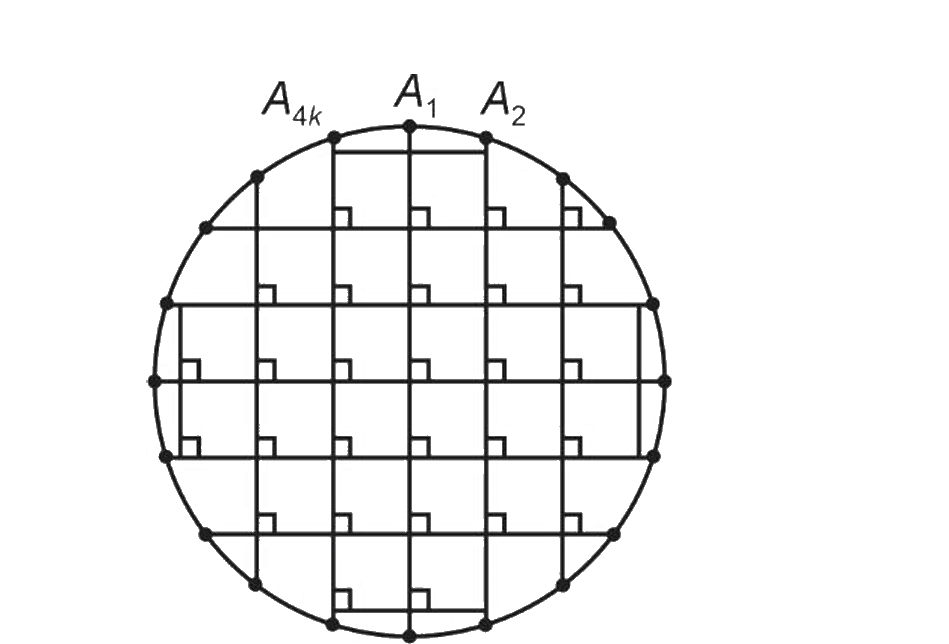
Case-I: Let n=4kn=4 k (1+3+5+…(2k−1)+…3+1)⋅k=(k2+(k−1)2)k≥1000⇒k(2k2−2k+1)≥1000⇒k≥9 as k∈N⇒4k≥36⇒n≥36\begin{aligned} & (1+3+5+\ldots(2 k-1)+\ldots 3+1) \cdot k \\ & =\left(k^2+(k-1)^2\right) k \geq 1000 \\ & \Rightarrow k\left(2 k^2-2 k+1\right) \geq 1000 \\ & \Rightarrow k \geq 9 \text { as } k \in N \\ & \Rightarrow 4 k \geq 36 \\ & \Rightarrow n \geq 36 \end{aligned} Case-II: n=4k+2(1+3+…2k−1)×2×(2k+1)⇒(2k+1)⋅2k2≥1000⇒k2(2k+1)≥500⇒k≥7⇒n≥30∴min⁡(36,30)=30\begin{aligned} & n=4 k+2 \\ & (1+3+\ldots 2 k-1) \times 2 \times(2 k+1) \\ & \Rightarrow(2 k+1) \cdot 2 k^2 \geq 1000 \\ & \Rightarrow k^2(2 k+1) \geq 500 \\ & \Rightarrow k \geq 7 \\ & \Rightarrow n \geq 30 \\ & \therefore \min (36,30)=30 \end{aligned}
Practice Permutation and Combination on Quantrex Academy →

More from Permutation and Combination

All Permutation and Combination questions Full Permutation and Combination list All Olympiad workbook PYQs