Quantrex Quantrex AcademyJEE · NEET · NDA PYQs with solutions Open app
JEE Main 201815 AprilEvening ShiftOnline
Exam
JEE Main
Year
2018
Date
15 April
Shift
Evening Shift
Mode
Online
Subject
Physics
Chapter
Laws of Motion

JEE Main 2018 · 15 April · Evening Shift · Online · Physics · Laws of Motion

A disc rotates about its axis of symmetry in a hoizontal plane at a...

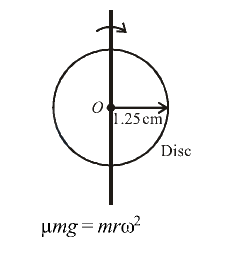
A disc rotates about its axis of symmetry in a hoizontal plane at a steady rate of 3.53.5 revolutions per second. A coin placed at a distance of 1.25 cm1.25 \mathrm{~cm} from the axis of rotation remains at rest on the disc. The coefficient of friction between the coin and the disc is (g=10 m/s2)\left(\mathrm{g}=10 \mathrm{~m} / \mathrm{s}^2\right)A disc rotates about its axis of symmetry in a hoizontal plane at a steady rate of 3.5 revolutions per second. A coinA disc rotates about its axis of symmetry in a hoizontal plane at a steady rate of 3.5 revolutions per second. A coin

Options

  1. A0.50.5
  2. B0.70.7
  3. C0.30.3
  4. D0.60.6

Correct answer

D. 0.60.6

Step-by-step solution

Using, μmg=mv2r=mrω2ω=2πn=2π×3.5=7πrad/sec\mu m g=\frac{m v^2}{r}=m r \omega^2\omega=2 \pi n=2 \pi \times 3.5=7 \pi \mathrm{rad} / \mathrm{sec} Radius, r=1.25 cm=1.25×10⁻² mr=1.25 \mathrm{~cm}=1.25 \times 10^{-2} \mathrm{~m} Coefficient of friction, μ=\mu= ? \mu m g=m(rω)2r(∵\frac{m(r \omega)^2}{r}(\becausev=r ω)<imgsrc="/api/proxy−image?url=https\omega)<img src="/api/proxy-image?url=https%3A%2F%2Ffirebasestorage.googleapis.com%2Fv0%2Fb%2Fquantrexacademy-app.firebasestorage.app%2Fo%2Fquestions%252Ffigs%252Fpyq%252Fjee_main%252F1Xab-Fppyfdxc4xAOFjxuM5hgcZzSg4IkXeeoc-kYb4.original.fullsize.png%3Falt%3Dmedia&clean=1&v=wm2" data-qx-orig-src="https://firebasestorage.googleapis.com/v0/b/quantrexacademy-app.firebasestorage.app/o/questions%2Ffigs%2Fpyq%2Fjee_main%2F1Xab-Fppyfdxc4xAOFjxuM5hgcZzSg4IkXeeoc-kYb4.original.fullsize.png?alt=media" data-qx-storage-src="https://firebasestorage.googleapis.com/v0/b/quantrexacademy-app.firebasestorage.app/o/questions%2Ffigs%2Fpyq%2Fjee_main%2F1Xab-Fppyfdxc4xAOFjxuM5hgcZzSg4IkXeeoc-kYb4.original.fullsize.png?alt=media"> \\ \begin{gathered} \Rightarrow \quad \mu=\frac{r \omega^2}{g}=\frac{1.25 \times 10^{-2} \times\left(7 \times \frac{22}{7}\right)^2}{10}\\ =\frac{1.25 \times 10^{-2} \times 22^2}{10}=0.6 \end{gathered}
Practice Laws of Motion on Quantrex Academy →

More from Laws of Motion

A block takes t time to slide down a plane inclined at 45° to the horizontal. If the… JEE Main 2026Two blocks ( P and Q ) with respectively masses 2 kg and 1.5 kg are joined by a massless… JEE Main 2026A mass of 1 kg is kept on an inclined plane with 30° inclination with respect to… JEE Main 2026Three masses m_1 = 4 kg, m_2 = 4 kg and m_3 = 6 kg are suspended from a fixed smooth… JEE Main 2026A wedge Y with mass of 10 kg and all frictionless surfaces and the inclined surface… JEE Main 2026At t=0 , a body of mass 100 g starts moving under the influence of a force (5 i +10 j )… JEE Main 2026The time taken by a block of mass m to slide down from the highest point to the lowest… JEE Main 2026A 0.5 kg mass is in contact against the inner wall of a cylindrical drum of radius 4 m… JEE Main 2026 Full Laws of Motion list All JEE Main PYQs