Quantrex Quantrex AcademyJEE · NEET · NDA PYQs with solutions Open app
JEE Main 20169 AprilOnline
Exam
JEE Main
Year
2016
Date
9 April
Mode
Online
Subject
Physics
Chapter
Laws of Motion

JEE Main 2016 · 9 April · Online · Physics · Laws of Motion

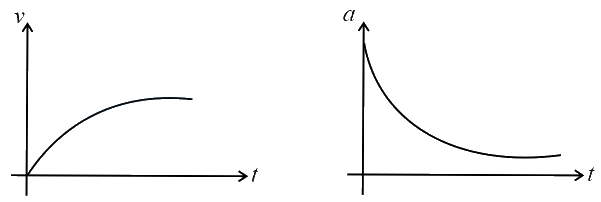
Which of the following option correctly describes the variation of...

Which of the following option correctly describes the variation of the speed υυ and acceleration 'a' of a point mass falling vertically in a viscous medium that applies a force F=−kυF = - kυ , where 'k' is a constant, on the body? (Graphs are schematic and not drown to scale)Which of the following option correctly describes the variation of the speed υ and acceleration 'a' of a point massWhich of the following option correctly describes the variation of the speed υ and acceleration 'a' of a point massWhich of the following option correctly describes the variation of the speed υ and acceleration 'a' of a point massWhich of the following option correctly describes the variation of the speed υ and acceleration 'a' of a point massWhich of the following option correctly describes the variation of the speed υ and acceleration 'a' of a point mass
Options

  1. AA capacitor C_1 of capacitance 1 and a capacitor C_2 of capacitance 2 are charged separately for a long time by a
  2. BA capacitor C_1 of capacitance 1 and a capacitor C_2 of capacitance 2 are charged separately for a long time by a
  3. CA capacitor C_1 of capacitance 1 and a capacitor C_2 of capacitance 2 are charged separately for a long time by a
  4. DA capacitor C_1 of capacitance 1 and a capacitor C_2 of capacitance 2 are charged separately for a long time by a

Correct answer

C. A capacitor C_1 of capacitance 1 and a capacitor C_2 of capacitance 2 are charged separately for a long time by a

Step-by-step solution

a=(g−αv)\text{a} = \text{(g} - \alpha \text{v)}

dvdt=\dfrac{\text{dv}}{\text{dt}} =g−αv\text{g} - \alpha \text{v}

∫0vdvg−αv=∫0tdt⇒ℓn(g−αvg)=−αt\mathop{∫}_{0}^{\text{v}}\dfrac{\text{dv}}{\text{g} - \alpha\text{v}} = \mathop{∫}_{0}^{\text{t}}\text{dt} ⇒ ℓ\text{n}\left(\dfrac{\text{g} - \alpha\text{v}}{\text{g}}\right) = - \alpha\text{t}

v=v0(1−e−αt)a=dvdt=v0αe−αt=a0e−αtv = {\text{v}}_{0}\left(1 - {\text{e}}^{- \alpha\text{t}}\right)\text{a} = \dfrac{\text{dv}}{\text{dt}} = {\text{v}}_{0}\alpha{\text{e}}^{- \alpha\text{t}} = {\text{a}}_{0}{\text{e}}^{- \alpha\text{t}}

Which of the following option correctly describes the variation of the speed υ and acceleration 'a' of a point mass

Practice Laws of Motion on Quantrex Academy →

More from Laws of Motion

A block takes t time to slide down a plane inclined at 45° to the horizontal. If the… JEE Main 2026Two blocks ( P and Q ) with respectively masses 2 kg and 1.5 kg are joined by a massless… JEE Main 2026A mass of 1 kg is kept on an inclined plane with 30° inclination with respect to… JEE Main 2026Three masses m_1 = 4 kg, m_2 = 4 kg and m_3 = 6 kg are suspended from a fixed smooth… JEE Main 2026A wedge Y with mass of 10 kg and all frictionless surfaces and the inclined surface… JEE Main 2026At t=0 , a body of mass 100 g starts moving under the influence of a force (5 i +10 j )… JEE Main 2026The time taken by a block of mass m to slide down from the highest point to the lowest… JEE Main 2026A 0.5 kg mass is in contact against the inner wall of a cylindrical drum of radius 4 m… JEE Main 2026 Full Laws of Motion list All JEE Main PYQs