Quantrex Quantrex AcademyJEE · NEET · NDA PYQs with solutions Open app
JEE Main 202126 AugustEvening Shift
Exam
JEE Main
Year
2021
Date
26 August
Shift
Evening Shift
Subject
Physics
Chapter
Nuclear Physics

JEE Main 2021 · 26 August · Evening Shift · Physics · Nuclear Physics

At time t = 0 , a material is composed of two radioactive atoms A...

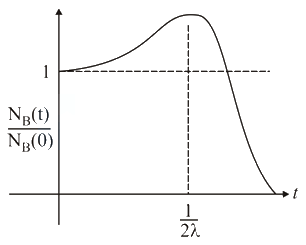
At time t=0t = 0, a material is composed of two radioactive atoms AA and BB, where NA(0)=2NB(0){N}_{A} ( 0 ) = 2{N}_{B} ( 0 ) The decay constant of both kind of radioactive atoms is λ\lambda. However, AA disintegrates to BB and BB disintegrates to CC. Which of the following figures represents the evolution of \dfrac{{N}_{B}\left(t\right)}{{N}_{B}\left(0\right)} with respect to time tt?At time t = 0 , a material is composed of two radioactive atoms A and B , where N _ A ( 0 ) = 2 N _ B ( 0 ) The decayAt time t = 0 , a material is composed of two radioactive atoms A and B , where N _ A ( 0 ) = 2 N _ B ( 0 ) The decayAt time t = 0 , a material is composed of two radioactive atoms A and B , where N _ A ( 0 ) = 2 N _ B ( 0 ) The decayAt time t = 0 , a material is composed of two radioactive atoms A and B , where N _ A ( 0 ) = 2 N _ B ( 0 ) The decayAt time t = 0 , a material is composed of two radioactive atoms A and B , where N _ A ( 0 ) = 2 N _ B ( 0 ) The decay

Options

  1. AIf the data are moderately non-symmetrical, then which one of the following empirical relationships is correct?
  2. BIf the data are moderately non-symmetrical, then which one of the following empirical relationships is correct?
  3. CIf the data are moderately non-symmetrical, then which one of the following empirical relationships is correct?
  4. DIf the data are moderately non-symmetrical, then which one of the following empirical relationships is correct?

Correct answer

C. If the data are moderately non-symmetrical, then which one of the following empirical relationships is correct?

Step-by-step solution

The rate at which nuclei of BB is forming,

dNBdt=λNA−λNB\dfrac{d{N}_{B}}{dt} = \lambda{N}_{A} - \lambda{N}_{B}

dNBdt=2λNB0e−\lambdat−λNB\dfrac{d{N}_{B}}{dt} = 2\lambda{N}_{B0}{e}^{- \lambdat} - \lambda{N}_{B}

e−\lambdat(dNBdt+λNB)=2λNB0e−\lambdate\lambdat{e}^{- \lambdat}\left(\dfrac{d{N}_{B}}{dt} + \lambda{N}_{B}\right) = 2\lambda{N}_{B0}{e}^{- \lambdat}{e}^{\lambdat}

ddt(NBe−\lambdat)=2λNB0\dfrac{d}{dt}\left({N}_{B}{e}^{- \lambdat}\right) = 2\lambda{N}_{B0}

on integrating above the equation,
NBe\lambdat=2\lambdatNB+NB0{N}_{B}{e}^{\lambdat} = 2\lambdat{N}_{B} + {N}_{{B}_{0}}
NBe\lambdat=2\lambdatNB0+NB0{N}_{B}{e}^{\lambdat} = 2\lambdat{N}_{B0} + {N}_{{B}_{0}}

NB=NB[1+2\lambdat]e−\lambdatddtNB=0{N}_{B} = {N}_{B}\left[1 + 2\lambdat\right]{e}^{- \lambdat}\dfrac{d}{dt}{N}_{B} = 0

−λ[1+2\lambdat]e−\lambdat+2λe−\lambdat=0NBmaxatt=12λ- \lambda\left[1 + 2\lambdat\right]{e}^{- \lambdat} + 2\lambda{e}^{- \lambdat} = 0{N}_{Bmax}att = \dfrac{1}{2\lambda}

At time t = 0 , a material is composed of two radioactive atoms A and B , where N _ A ( 0 ) = 2 N _ B ( 0 ) The decay

Practice Nuclear Physics on Quantrex Academy →

More from Nuclear Physics

A nuclear reactor starts producing a radioactive nuclide X from t = 0 , at a constant… JEE Advanced 2026Two radioactive substances A and B of mass numbers 200 and 212 respectively, shows… JEE Main 2026The energy released if hydrogen atoms are combined to form ^ 4 _ 2 He is __________ MeV.… JEE Main 2026The energy released when (7)/(17.13) kg of ^ 7 _ 3 Li is converted into ^ 4 _ 2 He by… JEE Main 2026Assuming the experimental mass of ^ 12 _ 6 C as 12 u , the mass defect of ^ 12 _ 6 C atom… JEE Main 2026Two nuclei of mass number 3 combine with another nucleus of mass number 4 to yield a… JEE Main 2026The binding energy per nucleon of ^ 209 _ 83 Bi is _______ MeV. [Take m(^ 209 _ 83 Bi) =… JEE Main 2026A nucleus has mass number α and radius R_ α . Another nucleus has mass number β and… JEE Main 2026 Full Nuclear Physics list All JEE Main PYQs