NEET
- Exam
- NEET
- Subject
- Zoology
- Chapter
- Neural Control and Coordination
NEET · Zoology · Neural Control and Coordination
Identify the state of the neuronal membrane and then choose not...
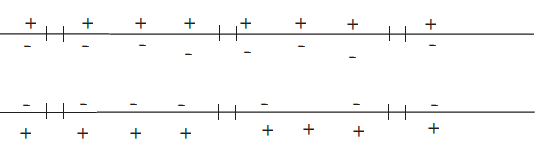
Identify the state of the neuronal membrane and then choose not incorrect statement.
Options
- AThe membrane is in a depolarised state.
- BOutside positive is due to efflux of potassium ions.
- CThe electrical potential difference across the resting plasma membrane is called as the action potential.
- DIn resting state, ionic gradients are maintained by sodium- potassium pump.
Correct answer
D. In resting state, ionic gradients are maintained by sodium- potassium pump.
Step-by-step solution
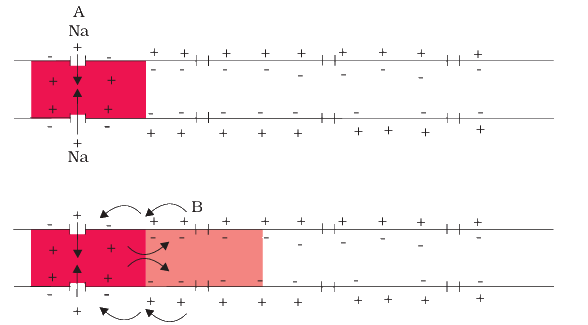
Similarly, the membrane is impermeable to negatively charged proteins present in the axoplasm. Consequently, the axoplasm inside the axon contains high concentration of K⁺ and negatively charged proteins and low concentration of Na⁺. In contrast, the fluid outside the axon contains a low concentration of K⁺, a high concentration of Na⁺ and thus form a concentration gradient. These ionic gradients across the resting membrane are maintained by the active transport of ions by the sodium-potassium pump which transports 3 Na⁺ outwards for 2 K⁺ into the cell. As a result, the outer surface of the axonal membrane possesses a positive charge while its inner surface becomes negatively charged and therefore is polarised. The electrical potential difference across the resting plasma membrane is called as the resting potential. The electrical potential difference across the plasma membrane at the site A is called the action potential, which is in fact termed as a nerve impulse. At sites immediately ahead, the axon (e.g., site B) membrane has a positive charge on the outer surface and a negative charge on its inner surface. As a result, a current flows on the inner surface from site A to site B. On the outer surface current flows from site B to site A to complete the circuit of current flow. Hence, the polarity at the site is reversed, and an action potential is generated at site B. Thus, the impulse (action potential) generated at site A arrives at site B. The sequence is repeated along the length of the axon and consequently the impulse is conducted. The rise in the stimulus-induced permeability to Na⁺ is extremely short lived. It is quickly followed by a rise in permeability to K⁺. Within a fraction of a second, K⁺ diffuses outside the membrane and restores the resting potential of the membrane at the site of excitation and the fibre becomes once more responsive to further stimulation.