Quantrex Quantrex AcademyJEE · NEET · NDA PYQs with solutions Open app
AIIMS 2010
Exam
AIIMS
Year
2010
Subject
Physics
Chapter
Laws of Motion

AIIMS 2010 · Physics · Laws of Motion

A block of mass m is pulled along a horizontal surface by applying...

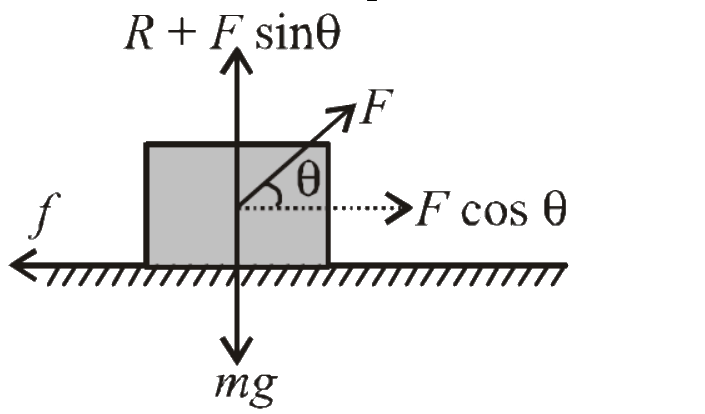
A block of mass mm is pulled along a horizontal surface by applying a force at an angle θ\theta with the horizontal. If the block travels with a uniform velocity and has a displacement dd and the coefficient of friction is μ\mu, then the work done by the applied force isA block of mass m is pulled along a horizontal surface by applying a force at an angle θ with the horizontal. If theA block of mass m is pulled along a horizontal surface by applying a force at an angle θ with the horizontal. If the

Options

  1. Aμmgdcos⁡θ+μsin⁡θ\frac{\mu m g d}{\cos \theta+\mu \sin \theta}
  2. Bμmgdcos⁡θcos⁡θ+μsin⁡θ\frac{\mu m g d \cos \theta}{\cos \theta+\mu \sin \theta}
  3. Cμmgdsin⁡θcos⁡θ+μsin⁡θ\frac{\mu m g d \sin \theta}{\cos \theta+\mu \sin \theta}
  4. Dμmgdcos⁡θcos⁡θ−μsin⁡θ\frac{\mu m g d \cos \theta}{\cos \theta-\mu \sin \theta}

Correct answer

B. μmgdcos⁡θcos⁡θ+μsin⁡θ\frac{\mu m g d \cos \theta}{\cos \theta+\mu \sin \theta}

Step-by-step solution

Because the block moves with a uniform velocity, the resultant force is zero. Resolving FF into horizontal component Fcos⁡θF \cos \theta and vertical component Fsin⁡θF \sin \theta, we get A block of mass m is pulled along a horizontal surface by applying a force at an angle θ with the horizontal. If the
R+Fsin⁡θ=mg or R=mg−Fsin⁡θ Also f=μR=μ(mg−Fsin⁡θ) But Fcos⁡θ=f or Fcos⁡θ=μ(mg−Fsin⁡θ) or F(cos⁡θ+μsin⁡θ)=\mumg∴F=μmgcos⁡θ+μsin⁡θ\begin{aligned}& R+F \sin \theta=m g \text{ or }R=m g-F \sin\theta\\ & \text{ Also }f=\mu R=\mu(m g-F \sin \theta)\\ & \text{ But }F \cos \theta=f \\ & \text{ or }F \cos\theta=\mu(m g-F \sin \theta)\\ & \text{ or }F(\cos\theta+\mu \sin \theta)=\mum g \\ & \therefore \quad F=\frac{\mu m g}{\cos \theta+\mu \sin \theta} \end{aligned}Work W=Fscos⁡θW=F s \cos \theta∴W=μmgdcos⁡θcos⁡θ+μsin⁡θ(∵s=d)\begin{aligned}& \therefore W=\frac{\mu m g d \cos \theta}{\cos \theta+\mu \sin \theta}\\ & (\because s=d) \end{aligned}$
Practice Laws of Motion on Quantrex Academy →

More from Laws of Motion

The magnitude and direction of the acceleration produced in a body of mass 5 kg when two… NEET 2026A box of mass 15 kg is kept on the floor of a stationary trolley. The coefficient of… NEET 2026A car travels on a circular racetrack of radius 50 m, which is banked at an angle θ . If… NEET 2026There are two inclined surface of equal length (L) and same angle of inclination 45^ ∘… NEET 2025A uniform rod of mass 20 kg and length 5 m leans against a smooth vertical wall making an… NEET 2025A box of mass 5 kg is pulled by a cord, up along a frictionless plane inclined at 30^ ∘… NEET 2024A bob is whirled in a horizontal circle by means of a string at an initial speed of 10… NEET 2024A horizontal force 10 N is applied to a block A as shown in figure. The mass of blocks A… NEET 2024 Full Laws of Motion list All AIIMS PYQs