Quantrex Quantrex AcademyJEE · NEET · NDA PYQs with solutions Open app
JEE Advanced 2017Paper 1
Exam
JEE Advanced
Year
2017
Paper
Paper 1
Subject
Mathematics
Chapter
Application of Derivatives

JEE Advanced 2017 · Paper 1 · Mathematics · Application of Derivatives

Let f(x) = x + _ e x - x _ e x,x ∈ (0, ∞) . • Column 1 contains...

Let f(x)=x+log⁡ex−xlog⁡ex,x∈(0,∞).<br/>f\left(x\right) = x + \log_{e} x - x{\log}_{e} x,x \in \left(0, \infty\right) .<br />•Column1containsinformationaboutzerosofColumn 1 contains information about zeros off\left(x\right),f′(x)andf′′(x), {f}^{′}\left(x\right) and {f}^{′′}\left(x\right) .
•• Column 2 contains information about the limiting behaviour of f(x),f′(x)andf′′(x)f\left(x\right), {f}^{′}\left(x\right) and {f}^{′′}\left(x\right) at infinity.
•• Column 3 contains information about increasing-decreasing nature of f(x)andf′(x).<br/><tableborder="1"><tbody><tr><td>Column1</td><td>Column2</td><td>Column3</td></tr><tr><td>(I)f\left(x\right) and {f}^{′}\left(x\right) .<br /> <table border="1"> <tbody> <tr> <td>Column 1</td> <td>Column 2</td> <td>Column 3</td> </tr> <tr> <td>(I)f\left(x\right)=0= 0 for some x∈(1,e2)x \in \left(1, {e}^{2}\right) (i) lim⁡x→∞f(x)=0\lim_{x \to \infty} f \left(x\right) = 0 (P) ff is increasing in (0, 1) (II) f′(x)=0{f}^{′}\left(x\right) = 0 for some xin(1,e)</td><td>(ii)xin \left(1, e\right)</td> <td>(ii)\lim_{x \to \infty} f\left(x\right) = - \infty</td><td>(Q)</td> <td>(Q)fisdecreasingin(e,e2)is decreasing in \left(e, {e}^{2}\right) (III) f′(x)=0{f}^{′}\left(x\right) = 0 for some x∈(0,1)</td><td>(iii)x \in \left(0, 1\right)</td> <td>(iii)\lim_{x \to \infty} {f}^{′}\left(x\right)=−∞= - \infty (R) f′{f}^{′} is increasing in (0, 1) (IV) f′′(x){f}^{′′}\left(x\right) = 0forsomefor somex \in \left(1, e\right)</td><td>(iv)</td> <td>(iv)\lim_{x \to \infty} {f}^{′′}\left(x\right) = 0</td><td>(S)</td> <td>(S){f}^{′}isdecreasingin(e,e2)is decreasing in \left(e, {e}^{2}\right) Which of the following options is the only Correct combination?Let f(x) = x + _ e x - x _ e x,x ∈ (0, ∞) . • Column 1 contains information about zeros of f(x) , f ^ ′ (x) and f ^ ′′Let f(x) = x + _ e x - x _ e x,x ∈ (0, ∞) . • Column 1 contains information about zeros of f(x) , f ^ ′ (x) and f ^ ′′
Options

  1. A(I) (i) (P)
  2. B(II) (ii) (Q)
  3. C(IV) (iv) (S)
  4. D(III) (iii) (R)

Correct answer

B. (II) (ii) (Q)

Step-by-step solution

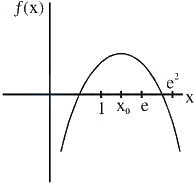
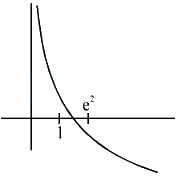
f\left(x\right) = x + ℓnx - xℓnx, x > 0</p><p></p><p>{f}^{'}\left(x\right) = 1 + \dfrac{1}{x} - ℓnx - 1</p><p></p><p>{f}^{''}\left(x\right) = - \dfrac{1}{{x}^{2}} - \dfrac{1}{x} = \dfrac{- \left(x + 1\right)}{{x}^{2}}</p><p><imgsrc="https://cdn−question−pool.getmarks.app/pyq/jeeadvanced/52to54solumathpap1.jpg"/></p><p>(I)</p><p><img src="https://cdn-question-pool.Quantrex.app/pyq/jee_advanced/52_to_54_solu_math_pap1.jpg"/></p><p>(I)f\left(1\right)f\left({e}^{2}\right) < 0, sotrue.</p><p>(II), so true.</p><p>(II){f}^{'}\left(1\right){f}^{'}\left(e\right) < 0,sotrue.</p><p>(III)Graphof, so true.</p><p>(III) Graph of{f}^{'}\left(x\right), so(III)isfalse.</p><p>(IV)Isfalse.</p><p>As, so (III) is false.</p><p>(IV) Is false.</p><p>As\lim_{x \to \infty} f\left(x\right) = \lim_{x \to \infty} x\left[1 + \dfrac{ℓnx}{x} - ℓnx\right] = - \infty</p><p></p><p>∴(i)isfalse(ii)istrue.</p><p>(i) is false (ii) is true.</p><p>\lim_{x \to \infty} {f}^{'}\left(x\right) = - \infty, so(iii)istrue.</p><p>, so (iii) is true.</p><p>\lim_{x \to \infty} {f}^{''}\left(x\right) = 0,so(iv)istrue.</p><p>(P),so (iv) is true.</p><p>(P){f}^{'}\left(x\right)ispositivein(0,1)sotrue</p><p>(Q)is positive in (0, 1) so true</p><p>(Q){f}^{'}\left(x\right) < 0forin(e,e2)for in \left(e, {e}^{2}\right) so true

As  f"(x)0{f}^{"}\left(x\right) 0 therefore, R is false, S is true.

Alternate:

f(x)=x+ℓnx−xℓnxf\left(x\right) = x + ℓnx - xℓnx

f′(x)=1x−ℓnx=0{f}^{'}\left(x\right) = \dfrac{1}{x} - ℓnx = 0 at x=x0x = {x}_{0} where x0∈(1,e){x}_{0} \in \left(1, e\right)

f′′(x)=−1x2−1x0⇒f(x){f}^{''}\left(x\right) = - \dfrac{1}{{x}^{2}} - \dfrac{1}{x} 0 ⇒ f\left(x\right) concave down

Let f(x) = x + _ e x - x _ e x,x ∈ (0, ∞) . • Column 1 contains information about zeros of f(x) , f ^ ′ (x) and f ^ ′′

Practice Application of Derivatives on Quantrex Academy →

More from Application of Derivatives

Consider the function f: (0, ∞) arrow (-∞, ∞) given by f(x) = x \, _e(x) - x + 1 . Then… JEE Advanced 2026Let P be the point on the parabola y = x^2 such that the slope of the tangent to the… JEE Advanced 2026Let f: ℝ arrow ℝ be a differentiable function such that f((x+y)/(3)) = (f(x) + f(y))/(3)… JEE Main 2026_ 0 ≤ x ≤ π (16 ((x)/(2)) ^3((x)/(2))) is equal to: JEE Main 2026Let f(x) be a polynomial of degree 5 , and have extrema at x = 1 and x = -1 . If _ x → 0… JEE Main 2026The number of critical points of the function f(x) = cases |( x)/(x)|, & x ≠ 0 1, & x = 0… JEE Main 2026Let f be a differentiable function satisfying f(x)=1-2 x+∫_ 0 ^ x e^ (x-t) f(t) dt, x ∈ R… JEE Main 2026Consider the following three statements for the function f:(0, ∞) arrow ℝ defined by… JEE Main 2026Let (2 α, α) be the largest interval in which the function f(t)= |t+1| t^ 2 , t 2 , is… JEE Main 2026Let f(x)=x^ 2025 -x^ 2000 , x ∈[0,1] and the minimum value of the function f(x) in the… JEE Main 2026Let f: ℝ → ℝ be a twice differentiable function such that f''(x) > 0 for all x ∈ ℝ and… JEE Main 2026Let f: R arrow R be a twice differentiable function such that the quadratic equation f(x)… JEE Main 2026Let ℝ denote the set of all real numbers. Define the function f: R arrow R by f(x)=\… JEE Advanced 2025Let ℝ denote the set of all real numbers. For a real number x , let [x] denote the… JEE Advanced 2025Let ℝ denote the set of all real numbers. Let f: ℝ arrow ℝ be defined by f(x)= cases (6… JEE Advanced 2025Let the function f(x)=(x)/(3)+(3)/(x)+3, x ≠ 0 be strictly increasing in (-∞, α_1) U(α_2… JEE Main 2025 Full Application of Derivatives list Application of Derivatives JEE Maths PYQsJEE Mathematics PYQs All JEE Advanced PYQs