
JEE Advanced 2013Paper 2
- Exam
- JEE Advanced
- Year
- 2013
- Paper
- Paper 2
- Subject
- Mathematics
- Chapter
- Inverse Trigonometric Functions
JEE Advanced 2013 · Paper 2 · Mathematics · Inverse Trigonometric Functions
Match List I with List II and select the correct answer using the...
Match List I with List II and select the correct answer using the code given below the lists :
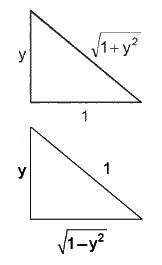
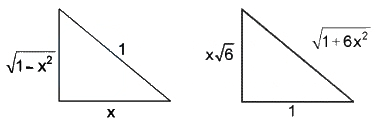
| List - I | List - II | ||
|---|---|---|---|
| A. | {\left(\dfrac{1}{{\text{y}}^{2}} \left(\dfrac{\text\cos \left({\text\tan}^{- 1} \text{y}\right) + \text{y sin} \left({\text\tan}^{- 1} \text{y}\right)}{\text{cot} \left({\text\sin}^{- 1} \text{y}\right) + \text\tan \left({\text\sin}^{- 1} \text{y}\right)}\right) + {\text{y}}^{4}\right)}^{1 / 2} takes value | P. | |
| B. | If \cos x + \cos y + \cos z = 0 = \sin x + \sin y + \sin z then possible value of cos | Q. | |
| C. | If \cos \left(\dfrac{\pi}{4} - \text{x}\right) \cos 2x then possible value of \sec x is | R. | |
| D. | If \cot \left({\text\sin}^{- 1} \sqrt{1 - {\text{x}}^{2}}\right) = \text\sin \left({\text\tan}^{- 1} \left(\text{x} \sqrt{6}\right)\right) \text{,} x \ne 0 \text{,} then possible value of x is | S. | 1 |
Options
- Aa-r;b-p;c-s;d-q;
- Ba-p;b-q;c-r;d-s;
- Ca-p;b-r;c-s;d-q;
- Da-s;b-r;c-q;d-p;
Correct answer
D. a-s;b-r;c-q;d-p;
Step-by-step solution
\left(\text{P}\right) - 4 \text{;} \left(\text{Q}\right) - 3 \text{;} \left(\text{R}\right) - 2 \text{or} 4 \text{;} \left(\text{S}\right) - 1<br />\left(\text{P}\right) {\left(\dfrac{1}{{y}^{2}} {\left(\dfrac{\text\cos \left({\text\tan}^{-1} y\right) + y \text\sin \left({\text\tan}^{-1} y\right)}{\text{cot} \left({\text\sin}^{-1} y\right) + \text\tan \left({\text\sin}^{-1} y\right)}\right)}^{2} + {y}_{4}\right)}^{1 / 2}
4
\left(\text{Q}\right) \text\cos x + \text\cos y = - \text\cos z
\text\sin x + \text\sin y = - \text\sin z \text{Square and add}
2 + 2 \text\cos \left(x - y\right) = 1
⇒ \text\cos \left(x - y\right) = - 1 / 2
⇒ 2 {\text\cos}^{2} \left(\dfrac{x - y}{2}\right) - 1 = - 1 / 2 \text{,} ⇒ \text\cos \left(\dfrac{x - y}{2}\right) = 1 / 2
3
\left(\text{R}\right) \text\cos 2 x \left(\text\cos \left(\dfrac{\pi}{4} - x\right) - \text\cos \left(\dfrac{\pi}{4} + x\right)\right) + 2 {\text\sin}^{2} x = 2 \text\sin x \text\cos x\text\cos 2 x \left(\sqrt{2} sin x\right) + 2 {\text\sin}^{2} x = 2 \text\sin x \text\cos x\sqrt{2} \text\sin x \left[\text\cos 2 x + \sqrt{2} \text\sin x - \sqrt{2} \text\cos x\right] = 0{\text\cos}^{2} x - {\text\sin}^{2} x = \sqrt{2} \left(\text\cos x - \text\sin x\right)⇒ \text{sec} x = \sqrt{2}<br />2 OR 4<br />\left(\text{S}\right) \text{cot} \left({\text\sin}^{-1} \sqrt{1 - {x}^{2}}\right) = \text\sin \left({\text\tan}^{-1} \left(x \sqrt{6}\right)\right)
1