Quantrex Quantrex AcademyJEE · NEET · NDA PYQs with solutions Open app
JEE Advanced 2020Paper 1
Exam
JEE Advanced
Year
2020
Paper
Paper 1
Subject
Physics
Chapter
Electrostatics

JEE Advanced 2020 · Paper 1 · Physics · Electrostatics

One end of a spring of negligible unstretched length and spring...

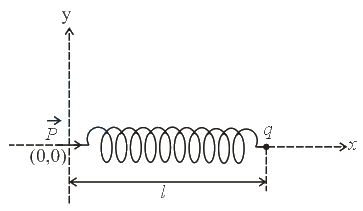
One end of a spring of negligible unstretched length and spring constant kk is fixed at the origin (0,0)( 0, 0 ). A point particle of mass mm carrying a positive charge qq is attached at its other end. The entire system is kept on a smooth horizontal surface. When a point dipole p→\overset{\to}{p} pointing towards the charge qq is fixed at the origin, the spring gets stretched to a length ll and attains a new equilibrium position (see figure below). If the point mass is now displaced slightly by \Deltal≪l\Deltal ≪ l from its equilibrium position and released, it is found to oscillate at frequency 1δkm,\dfrac{1}{\delta}\sqrt{\dfrac{k}{m}}, The value of δ\delta is _______. One end of a spring of negligible unstretched length and spring constant k is fixed at the origin ( 0, 0 ) . A point

Correct answer

0

Step-by-step solution

Original frequency f=12πkmf = \dfrac{1}{2\pi}\sqrt{\dfrac{k}{m}}

If dipole appears,

At equilibrium

2Kp(ℓ+x0)3⋅q=kx0...(i)\dfrac{2Kp}{{\left(ℓ + {x}_{0}\right)}^{3}} \cdot q = k{x}_{0} . . . \left(i\right)

One end of a spring of negligible unstretched length and spring constant k is fixed at the origin ( 0, 0 ) . A point

Now disturbed

2Kp(ℓ+x0+x)3⋅q−k(x0+x)=ma\dfrac{2Kp}{{\left(ℓ + {x}_{0} + x\right)}^{3}} \cdot q - k\left({x}_{0} + x\right) = ma

⇒ma=2Kpq(ℓ+x0)3[1+xℓ+x0]−3−k(x0+x)⇒ ma = \dfrac{2Kpq}{{\left(ℓ + {x}_{0}\right)}^{3}}{\left[1 + \dfrac{x}{ℓ + {x}_{0}}\right]}^{- 3} - k\left({x}_{0} + x\right)

⇒ma=2Kpq(ℓ+x0)3[1−3xℓ+x0]−3−k(x0+x)=−6Kpqx(ℓ+x0)4−kx⇒ ma = \dfrac{2Kpq}{{\left(ℓ + {x}_{0}\right)}^{3}}{\left[1 - \dfrac{3x}{ℓ + {x}_{0}}\right]}^{- 3} - k\left({x}_{0} + x\right) = - \dfrac{6Kpqx}{{\left(ℓ + {x}_{0}\right)}^{4}} - kx

=−3xℓ+x0kx0−kx=−kx[3x0ℓ+x0+1]= - \dfrac{3x}{ℓ + {x}_{0}}k{x}_{0} - kx = - kx\left[\dfrac{3{x}_{0}}{ℓ + {x}_{0}} + 1\right]

Asℓℓ is negative,   

ma=−4kxma = - 4kx;   ⇒a=4kmx⇒ a = \dfrac{4k}{m}x

New frequency :

f′=12π4km=2f{f}^{'} = \dfrac{1}{2\pi}\sqrt{\dfrac{4k}{m}} = 2f =1δkm= \dfrac{1}{\delta}\sqrt{\dfrac{k}{m}}

∴δ=π=3.14∴ \delta = \pi = 3 . 14

Practice Electrostatics on Quantrex Academy →

More from Electrostatics

Two charges Q_1 = q and Q_2 = mq are placed at the points P_1(a, b) and P_2(ma, mb)… JEE Advanced 2026Consider an electric dipole comprising two charges +q and -q each with mass m , separated… JEE Advanced 2026Two point charges q_1=3\,μ C and q_2=-4\,μ C are placed at points (2 i +3 j +3 k ) and (… JEE Main 2026The electric potential as a function of x, y is given by V = 5(x^2 - y^2) V. The electric… JEE Main 2026A thin half ring of radius 35 cm is uniformly charged with a total charge of Q coulomb.… JEE Main 2026A three coulomb charge moves from the point (0, -2, -5) to the point (5, 1, 2) in an… JEE Main 2026A particle of charge q and mass m is projected from origin with an initial velocity v = (… JEE Main 2026A rigid dipole undergoes a simple harmonic motion about its centre in the presence of an… JEE Main 2026 Full Electrostatics list All JEE Advanced PYQs