
JEE Advanced 2009Paper 1
- Exam
- JEE Advanced
- Year
- 2009
- Paper
- Paper 1
- Subject
- Physics
- Chapter
- Electrostatics
JEE Advanced 2009 · Paper 1 · Physics · Electrostatics
Six point charges, each of the same magnitude q , are arranged in...
Six point charges, each of the same magnitude , are arranged in different manners as shown in Column-II. In each case, a point and a line passing through are shown. Let be the electric field and be the electric potential at (potential at infinity is zero) due to the given charge distribution when it is at rest. Now, the whole system is set into rotation with a constant angular velocity about the line . Let the magnetic field at and be the magnetic moment of the system in this condition. Assume each rotating charge to be equivalent to a steady current.
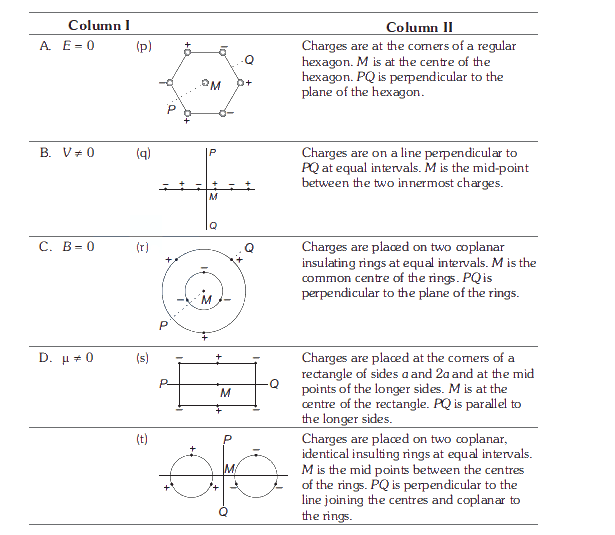
Options
- A(A) q,t, (B) q,s, (C) p,q,t, (D) r,s,t
- B(A) q,r,s, (B) r,s, (C) p,r, (D) r,s,t
- C(A) p,r,s, (B) r,s, (C) p,q,t, (D) r,s
- D(A) p,r, (B) q,s, (C) p,r,t, (D) r,s
Correct answer
C. (A) p,r,s, (B) r,s, (C) p,q,t, (D) r,s
Step-by-step solution
Concise justification (one line per match):
- A: .
Each of these arrangements is point-symmetric about so the vector sum of electric fields cancels at : (p) alternating charges on a regular hexagon, (r) concentric rings with symmetric charge placement, (s) symmetrical rectangle with charges at corners/midpoints.
- B: (V ≠ 0 ), s.
Potential is a scalar sum and need not cancel even if fields cancel; in () and () the positive and negative charges sit at different radii/positions so the net scalar potential at is nonzero.
- C: (B=0 ).
When the whole system rotates about the shown axis the circulating currents from oppositely-signed charges cancel pairwise in these configurations, giving zero magnetic field at .
- (: \mu ).
In (r) and (s) the rotating charges produce unequal effective current loops (different radii or an unbalanced loop geometry), so a net magnetic moment remains.
Hence choice (3).