Quantrex Quantrex AcademyJEE · NEET · NDA PYQs with solutions Open app
JEE Advanced 2009Paper 2
Exam
JEE Advanced
Year
2009
Paper
Paper 2
Subject
Physics
Chapter
Wave Optics

JEE Advanced 2009 · Paper 2 · Physics · Wave Optics

Column I shows four situations of standard Young's double slit...

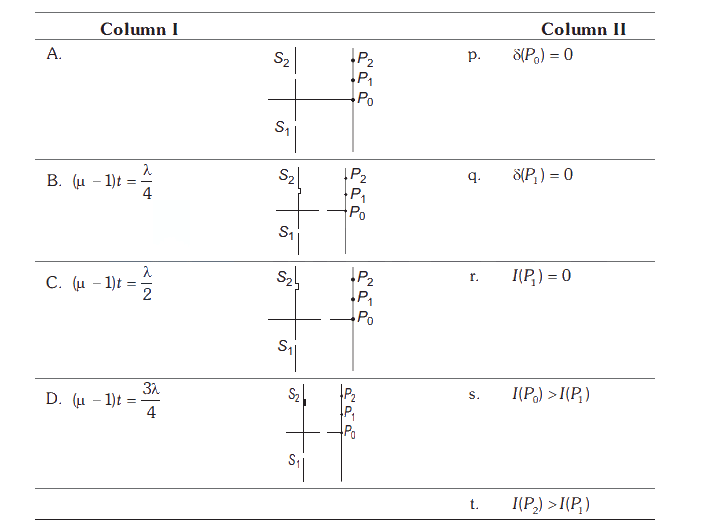
Column I shows four situations of standard Young's double slit arrangement with the screen placed far away from the slits S1S_1 and S2S_2. In each of these cases S1P0=S2P0S_1 P_0=S_2 P_0, S1P1−S2P1=λ4S_1 P_1-S_2 P_1=\frac{\lambda}{4} and S1P2−S2P2=λ3S_1 P_2-S_2 P_2=\frac{\lambda}{3}, where λ\lambda is the wavelength of the light used. In the cases B,C\mathrm{B}, \mathrm{C} and D\mathrm{D}, a transparent sheet of refractive index μ\mu and thickness tt is pasted on slit S2S_2. The thickness of the sheets are different in different cases. The phase difference between the light waves reaching a point PP on the screen from the two slits is denoted by δ(P)\delta(P) and the intensity by I(P)I(P). Match each situation given in Column-I with the statement(s) in Column-II valid for that situation. Column I shows four situations of standard Young's double slit arrangement with the screen placed far away from the
Options

  1. A(A) q,t, (B) q, (C) t, (D) r,s,t
  2. B(A) q,r,s, (B) r, (C) q,r, (D) q,s,t
  3. C(A) p,s, (B) r, (C) q,t, (D) r,s
  4. D(A) p,s, (B) q, (C) t, (D) r,s,t

Correct answer

D. (A) p,s, (B) q, (C) t, (D) r,s,t

Step-by-step solution

(A) →(p,s)→\rightarrow(\mathrm{p}, \mathrm{s}) \rightarrow Intensity at P0P_0 is maximum. It will continuously decrease from P0P_0 towards P2P_2. (B)→(q)→(B) \rightarrow(q) \rightarrow Path difference due to slap will be compensated by geometrical path difference. Hence, δ(P1)=0\delta\left(P_1\right)=0. (C)→(t)→δ(P0)=λ2,δ(P1)=λ2−λ4=λ4(\mathrm{C}) \rightarrow(\mathrm{t}) \rightarrow \delta\left(P_0\right)=\frac{\lambda}{2}, \delta\left(P_1\right)=\frac{\lambda}{2}-\frac{\lambda}{4}=\frac{\lambda}{4} and δ(P2)=λ2−λ3=λ6\delta\left(P_2\right)=\frac{\lambda}{2}-\frac{\lambda}{3}=\frac{\lambda}{6}. When path difference increases from 0 to λ2\frac{\lambda}{2}, intensity will decrease from maximum to zero. Hence, in this case, I(P2)>I(P1)>I(P0)I\left(P_2\right)>I\left(P_1\right)>I\left(P_0\right) (D)→(r,s,t)(\mathrm{D}) \rightarrow(\mathrm{r}, \mathrm{s}, \mathrm{t}) δ(P0)=3λ4,δ(P1)=3λ4−λ4=λ2\delta\left(P_0\right)=\frac{3 \lambda}{4}, \delta\left(P_1\right)=\frac{3 \lambda}{4}-\frac{\lambda}{4}=\frac{\lambda}{2} and δ(P2)=3λ4−λ3=5λ12\delta\left(P_2\right)=\frac{3 \lambda}{4}-\frac{\lambda}{3}=\frac{5 \lambda}{12} In this case I(P1)=0I\left(P_1\right)=0
Practice Wave Optics on Quantrex Academy →

More from Wave Optics

In the List-I, four optical effects are mentioned. The physical phenomena of light which… JEE Advanced 2026In a single slit diffraction experiment, a slit of width (0.016 ± 0.002) mm is used to… JEE Advanced 2026As shown in the figure, a ray AB of unpolarized light enters from water of refractive… JEE Advanced 2026Some distant star is to be observed by some telescope of diameter of objective lens a… JEE Main 2026In a Young double slit experiment, the wavelength of incident light is 6000 Å, the… JEE Main 2026In interference experiment the path difference between two interfering waves at a point A… JEE Main 2026An unpolarized light of intensity I_o passes through polarizer and then through a certain… JEE Main 2026The maximum intensity in a Young's double slit experiment is I_0 . Distance between the… JEE Main 2026 Full Wave Optics list All JEE Advanced PYQs