Quantrex Quantrex AcademyJEE · NEET · NDA PYQs with solutions Open app
Concepts Of Physics MCQ Edition [Volume 1]
Exam
Concepts Of Physics MCQ Edition [Volume 1]
Subject
Physics
Chapter
Rotational Mechanics

Concepts Of Physics MCQ Edition [Volume 1] · Physics · Rotational Mechanics

A light rod of length 1 m is pivoted at its centre, with two masses...

A light rod of length 1 m1\text{ m} is pivoted at its centre, with two masses of 5 kg5\text{ kg} and 2 kg2\text{ kg} suspended from its ends, as shown in the figure. Determine the initial angular acceleration of the rod, assuming it is horizontal at the beginning.
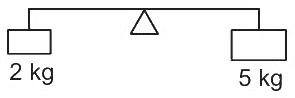
A light rod of length 1 m is pivoted at its centre, with two masses of 5 kg and 2 kg suspended from its ends, as shown

Options

  1. A8.4 rad/s28.4\text{ rad/s}^2
  2. B14.7 rad/s214.7\text{ rad/s}^2
  3. C2.1 rad/s22.1\text{ rad/s}^2
  4. D4.2 rad/s24.2\text{ rad/s}^2

Correct answer

A. 8.4 rad/s28.4\text{ rad/s}^2

Step-by-step solution

Let the length of the rod be L=1 mL = 1\text{ m}. Since the rod is pivoted at its centre, the distance of each mass from the pivot is r=L2=0.5 mr = \dfrac{L}{2} = 0.5\text{ m}.

The forces acting on the system are the weights of the two masses. The net torque τ\tau about the pivot is the difference between the torques produced by the 5 kg5\text{ kg} and 2 kg2\text{ kg} masses:

τ=m1gr−m2gr=(m1−m2)gr\tau = m_1 g r - m_2 g r = (m_1 - m_2) g r

Substituting the given values (taking g=9.8 m/s2g = 9.8\text{ m/s}^2):

τ=(5−2)×9.8×0.5=3×4.9=14.7 N m\tau = (5 - 2) \times 9.8 \times 0.5 = 3 \times 4.9 = 14.7\text{ N m}

The total moment of inertia II of the system about the pivot, assuming the rod is light (massless), is the sum of the moments of inertia of the two point masses:

I=m1r2+m2r2=(m1+m2)r2I = m_1 r^2 + m_2 r^2 = (m_1 + m_2) r^2

I=(5+2)×(0.5)2=7×0.25=1.75 kg m2I = (5 + 2) \times (0.5)^2 = 7 \times 0.25 = 1.75\text{ kg m}^2

Using Newton's second law for rotation, τ=Iα\tau = I \alpha, we can find the initial angular acceleration α\alpha:

α=τI=14.71.75=8.4 rad/s2\alpha = \dfrac{\tau}{I} = \dfrac{14.7}{1.75} = 8.4\text{ rad/s}^2
Practice Rotational Mechanics on Quantrex Academy →

More from Rotational Mechanics

A wheel revolves about its axis with a uniform angular acceleration. Beginning from rest… Concepts Of Physics MCQ Edition [Volume 1]Starting from rest, a wheel is uniformly accelerated at 4 rad/s^2 for 10 seconds.… Concepts Of Physics MCQ Edition [Volume 1]Determine the angular velocity of a body rotating with an acceleration of 2 rev/s^2 as it… Concepts Of Physics MCQ Edition [Volume 1]A body rotates about a fixed axis with an angular acceleration of one… Concepts Of Physics MCQ Edition [Volume 1]A disc of radius 10 cm rotates about its axis with an angular speed of 20 rad/s .… Concepts Of Physics MCQ Edition [Volume 1]A disc of radius 10 cm rotates about its axis with an angular speed of 20 rad/s .… Concepts Of Physics MCQ Edition [Volume 1]A disc rotates about its axis with a uniform angular acceleration of 4 rad/s^2 .… Concepts Of Physics MCQ Edition [Volume 1]A block is suspended from a string wrapped on a disc of radius 20 cm , which is free to… Concepts Of Physics MCQ Edition [Volume 1] Full Rotational Mechanics list All Concepts Of Physics MCQ Edition [Volume 1] PYQs