
Concepts Of Physics MCQ Edition [Volume 1]
- Exam
- Concepts Of Physics MCQ Edition [Volume 1]
- Subject
- Physics
- Chapter
- Rotational Mechanics
Concepts Of Physics MCQ Edition [Volume 1] · Physics · Rotational Mechanics
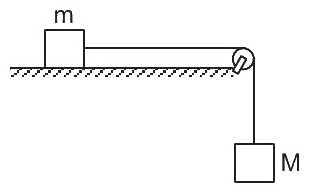
As depicted in the figure, two blocks of masses m and M are linked...
As depicted in the figure, two blocks of masses and are linked by a string that passes over a pulley. The horizontal table on which the mass slides is smooth. The pulley, which can freely rotate about its axis, has a radius and a moment of inertia about this axis. Determine the acceleration of the mass , assuming the string does not slip on the pulley.
Options
- A
- B
- C
- D
Correct answer
D.
Step-by-step solution
Let be the acceleration of the blocks and be the angular acceleration of the pulley.
Since the string does not slip on the pulley, the relation between linear and angular acceleration is .
Let be the tension in the horizontal segment of the string attached to mass , and be the tension in the vertical segment attached to mass .
Writing the equations of motion for each component:
For mass (moving downwards):
For mass (moving horizontally on a smooth table):
For the pulley (rotating about its axis):
Substituting into the torque equation:
Now, adding the equations for mass , mass , and the pulley:
Solving for , we get: