
Concepts Of Physics MCQ Edition [Volume 1]
- Exam
- Concepts Of Physics MCQ Edition [Volume 1]
- Subject
- Physics
- Chapter
- Rotational Mechanics
Concepts Of Physics MCQ Edition [Volume 1] · Physics · Rotational Mechanics
Two small balls A and B , each having mass m , are rigidly attached...
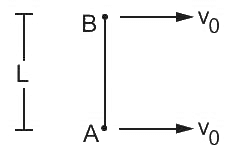
Two small balls and , each having mass , are rigidly attached to the ends of a light rod of length as depicted in the figure. On a frictionless horizontal surface, the system translates with a velocity in a direction perpendicular to the rod. A particle of mass , initially at rest on the surface, sticks to the ball when they collide. Determine the linear speeds of the balls and immediately after the collision. [Hint: The light rod will exert a force on the ball only along its length.]
Options
- A,
- B,
- C,
- D,
Correct answer
C. ,
Step-by-step solution
According to the given hint, the light rod can exert an impulsive force only along its length.
During the collision, the impulsive force between particle and ball acts in a direction perpendicular to the rod. Since the rod cannot transmit any impulse perpendicular to its length, it exerts zero transverse impulse on ball .
As a result, the velocity of ball remains unchanged immediately after the collision:
For the system comprising ball and particle , there is no external impulsive force in the direction perpendicular to the rod. Applying the principle of conservation of linear momentum for this system in the transverse direction:
The impulse along the rod must be zero because the relative velocity of and along the rod must remain zero, and there are no initial velocities or external impulses in that direction. Thus, the linear speeds immediately after the collision are and .