
Concepts Of Physics MCQ Edition [Volume 1]
- Exam
- Concepts Of Physics MCQ Edition [Volume 1]
- Subject
- Physics
- Chapter
- Rotational Mechanics
Concepts Of Physics MCQ Edition [Volume 1] · Physics · Rotational Mechanics
Pivoted at its upper end, a metre stick weighing 240 g is able to...
Pivoted at its upper end, a metre stick weighing is able to freely rotate in a vertical plane through this end, as shown in the figure. A particle of mass is attached to the upper end of the stick by a light string of length . Initially, the rod is held vertical and the string horizontal when the system is released from rest. The particle collides with the stick's lower end and sticks to it. Determine the maximum angle through which the stick will rise.
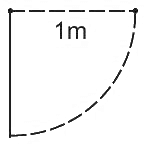
Options
- A
- B
- C
- D
Correct answer
D.
Step-by-step solution
Let the mass of the stick be and its length be .
Let the mass of the particle be .
The particle falls through a height , so its velocity just before the collision is .
The angular momentum of the particle about the pivot just before the collision is:
After the collision, the particle sticks to the lower end of the stick. The moment of inertia of the system (stick + particle) about the pivot is:
By conservation of angular momentum about the pivot during the collision:
The kinetic energy of the system just after the collision is:
When the system swings to a maximum angle , the center of mass of the stick rises by and the particle rises by . The increase in potential energy is:
By conservation of mechanical energy after the collision, :
Substituting and :
Since and , the angle is approximately .
Answer: