
Concepts Of Physics MCQ Edition [Volume 1]
- Exam
- Concepts Of Physics MCQ Edition [Volume 1]
- Subject
- Physics
- Chapter
- Rotational Mechanics
Concepts Of Physics MCQ Edition [Volume 1] · Physics · Rotational Mechanics
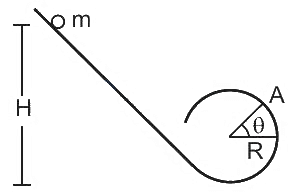
As shown in the figure, a small spherical ball of mass m rolls down...
As shown in the figure, a small spherical ball of mass rolls down a loop track. The ball is released on the linear portion at a vertical height from the lowest point. The circular part shown has a radius . Determine the kinetic energy of the ball when it is at a point , where the radius makes an angle with the horizontal.
Options
- A
- B
- C
- D
Correct answer
C.
Step-by-step solution
Let the lowest point of the loop track be the reference level for zero gravitational potential energy ().
The ball is released from rest at a vertical height . Therefore, its initial kinetic energy is zero, and its initial mechanical energy is entirely potential:
At point A, the radius of the circular track makes an angle with the horizontal. The center of the circular loop is at a height from the lowest point. The vertical height of point A from the center of the loop is .
Thus, the total height of point A from the lowest point is:
The potential energy of the ball at point A is:
Since the ball rolls down the track, the point of contact is instantaneously at rest, meaning the static friction does no work. Therefore, the total mechanical energy of the system is conserved.
Let be the total kinetic energy of the ball at point A. By the principle of conservation of mechanical energy:
Substituting the values, we get:
Solving for the total kinetic energy :
Note: The total kinetic energy is simply the loss in potential energy. If the question had specifically asked for the *translational* kinetic energy, it would be , but "kinetic energy" of a rolling body refers to its total kinetic energy (translational + rotational).
Answer: