
Concepts Of Physics MCQ Edition [Volume 1]
- Exam
- Concepts Of Physics MCQ Edition [Volume 1]
- Subject
- Physics
- Chapter
- Sound Waves
Concepts Of Physics MCQ Edition [Volume 1] · Physics · Sound Waves
A sound source S and a detector D are located at some distance from...
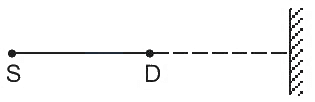
A sound source and a detector are located at some distance from each other. A large cardboard is placed near the detector, perpendicular to the line , as shown in the figure. The cardboard is gradually moved away, and it is observed that the intensity varies from a maximum to a minimum when the board is displaced by a distance of . Determine the frequency of the emitted sound. The velocity of sound in air is .
Options
- A
- B
- C
- D
Correct answer
C.
Step-by-step solution
Let the distance between the detector and the cardboard be .
The sound waves reaching the detector consist of the direct wave from the source and the reflected wave from the cardboard. The reflected wave travels an additional distance from the detector to the cardboard and back. Thus, the path difference between the direct and reflected waves is:
When the cardboard is displaced by a distance , the new path difference becomes . The change in the path difference is:
For the intensity at the detector to vary from a maximum (constructive interference) to an adjacent minimum (destructive interference), the change in path difference must be equal to half of the wavelength .
Equating the two expressions for the change in path difference:
The frequency of the emitted sound can be calculated using the wave speed equation :