Quantrex Quantrex AcademyJEE · NEET · NDA PYQs with solutions Open app
Concepts Of Physics MCQ Edition [Volume 1]
Exam
Concepts Of Physics MCQ Edition [Volume 1]
Subject
Physics
Chapter
Sound Waves

Concepts Of Physics MCQ Edition [Volume 1] · Physics · Sound Waves

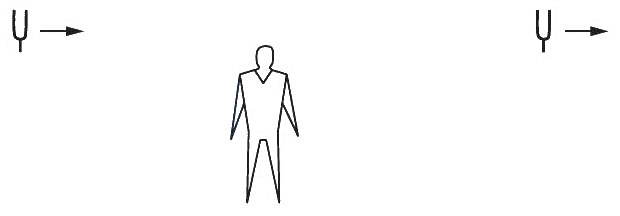
As shown in the figure, a person is standing somewhere between two...

As shown in the figure, a person is standing somewhere between two identical tuning forks that are each vibrating at 512 Hz512 \text{ Hz}. If both tuning forks travel towards the right at a speed of 5.5 m s−15.5 \text{ m s}^{-1}, determine the number of beats heard by the listener. The speed of sound in air is 330 m s−1330 \text{ m s}^{-1}.
As shown in the figure, a person is standing somewhere between two identical tuning forks that are each vibrating at

Options

  1. A8.5 Hz8.5 \text{ Hz}
  2. B17.1 Hz17.1 \text{ Hz}
  3. C34.1 Hz34.1 \text{ Hz}
  4. D17.5 Hz17.5 \text{ Hz}

Correct answer

B. 17.1 Hz17.1 \text{ Hz}

Step-by-step solution

Given:
Frequency of tuning forks, f=512 Hzf = 512 \text{ Hz}
Speed of tuning forks, vs=5.5 m s−1v_s = 5.5 \text{ m s}^{-1}
Speed of sound, v=330 m s−1v = 330 \text{ m s}^{-1}

The tuning fork on the left moves towards the stationary listener. The apparent frequency heard by the listener is:
f1=f(vv−vs)f_1 = f \left( \dfrac{v}{v - v_s} \right)

The tuning fork on the right moves away from the stationary listener. The apparent frequency heard by the listener is:
f2=f(vv+vs)f_2 = f \left( \dfrac{v}{v + v_s} \right)

The number of beats heard by the listener is the difference between these two apparent frequencies:
fB=f1−f2=f(vv−vs−vv+vs)f_B = f_1 - f_2 = f \left( \dfrac{v}{v - v_s} - \dfrac{v}{v + v_s} \right)

fB=fv(v+vs−(v−vs)v2−vs2)=2fvvsv2−vs2f_B = fv \left( \dfrac{v + v_s - (v - v_s)}{v^2 - v_s^2} \right) = \dfrac{2 f v v_s}{v^2 - v_s^2}

Since vs≪vv_s \ll v, we can approximate v2−vs2≈v2v^2 - v_s^2 \approx v^2:
fB≈2fvvsv2=2fvsvf_B \approx \dfrac{2 f v v_s}{v^2} = \dfrac{2 f v_s}{v}

Substituting the given values:
fB=2×512×5.5330f_B = \dfrac{2 \times 512 \times 5.5}{330}

fB=512×11330=51230≈17.067 Hzf_B = \dfrac{512 \times 11}{330} = \dfrac{512}{30} \approx 17.067 \text{ Hz}

Rounding to one decimal place, we get 17.1 Hz17.1 \text{ Hz}.
Practice Sound Waves on Quantrex Academy →

More from Sound Waves

A steel tube of length 1.00 m is struck at one end. A person with an ear close to the… Concepts Of Physics MCQ Edition [Volume 1]A man stands in front of a large wall at a distance of 50.0 m and claps his hands at… Concepts Of Physics MCQ Edition [Volume 1]Determine the minimum and maximum wavelengths of sound in water within the audible range… Concepts Of Physics MCQ Edition [Volume 1]A person is able to hear sound waves within the frequency range of 20 Hz to 20 kHz .… Concepts Of Physics MCQ Edition [Volume 1]Sound is primarily transmitted in the forward direction when its wavelength is… Concepts Of Physics MCQ Edition [Volume 1]Sound waves from a loudspeaker propagate nearly uniformly in all directions when the… Concepts Of Physics MCQ Edition [Volume 1]During a spiritual gathering, the devotees chant HARE-RAM HARE-RAM. The sound is… Concepts Of Physics MCQ Edition [Volume 1]A travelling sound wave is described by the equation y = 6.0 (600 t - 1.8 x) , with y… Concepts Of Physics MCQ Edition [Volume 1] Full Sound Waves list All Concepts Of Physics MCQ Edition [Volume 1] PYQs