
Concepts Of Physics MCQ Edition [Volume 2]
- Exam
- Concepts Of Physics MCQ Edition [Volume 2]
- Subject
- Physics
- Chapter
- Electric Current in Conductors
Concepts Of Physics MCQ Edition [Volume 2] · Physics · Electric Current in Conductors
Twelve wires, each with an equal resistance r , are connected to...
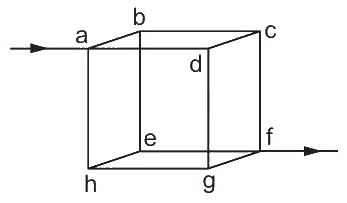
Twelve wires, each with an equal resistance , are connected to form a cube as shown in the figure. Calculate the equivalent resistance between the diagonally opposite points and .
Options
- A
- B
- C
- D
Correct answer
D.
Step-by-step solution
Let the total current entering at junction be and leaving at junction be .
Due to the symmetry of the cube, the current divides equally into three identical paths at junction .
Current in branches , , and is .
At junction , the current further divides equally into branches and because the paths to are symmetric.
Current in branches and is .
Similarly, the current in branches , , , and is .
At junction , currents from and combine. So, the current in branch is .
The potential difference between points and along the path is:
The equivalent resistance is given by: