
Concepts Of Physics MCQ Edition [Volume 2]
- Exam
- Concepts Of Physics MCQ Edition [Volume 2]
- Subject
- Physics
- Chapter
- Electric Current in Conductors
Concepts Of Physics MCQ Edition [Volume 2] · Physics · Electric Current in Conductors
Determine the equivalent resistances between the points a and b for...
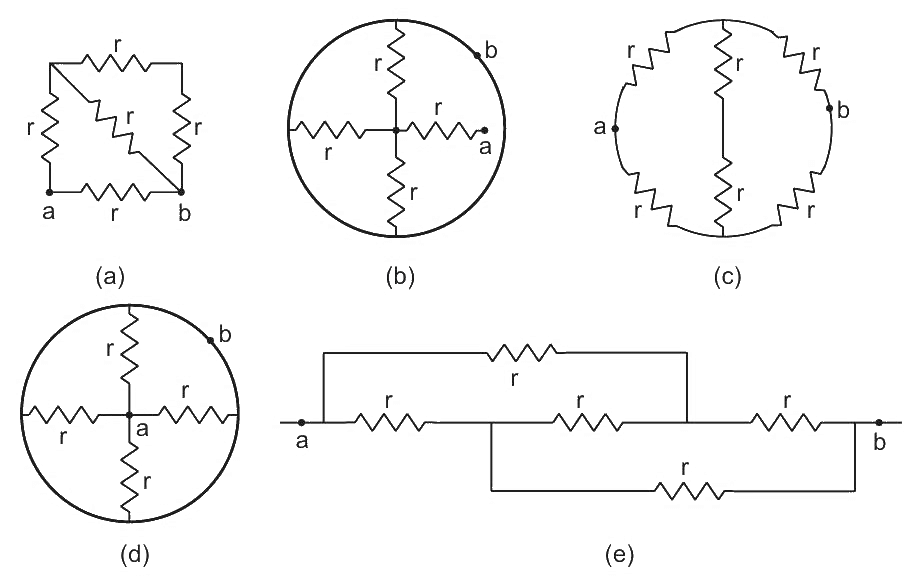
Determine the equivalent resistances between the points and for the networks depicted in the given figure.
Options
- A(a) , (b) , (c) , (d) , (e)
- B(a) , (b) , (c) , (d) , (e)
- C(a) , (b) , (c) , (d) , (e)
- D(a) , (b) , (c) , (d) , (e)
Correct answer
A. (a) , (b) , (c) , (d) , (e)
Step-by-step solution
For network (a), let the nodes be (bottom-left), (bottom-right), C (top-left), and D (top-right).
The resistors between C and D, and D and are in series. Their equivalent resistance is .
This combination is in parallel with the diagonal resistor between C and . The equivalent resistance is .
This is in series with the resistor between and C. The equivalent resistance of this upper branch is .
Finally, this upper branch is in parallel with the resistor between and . The total equivalent resistance is .
For network (b), let the central node be O. The outer circle acts as a single conducting node, let's call it C.
Node is on the circle, so it is at the same potential as C.
Three resistors connect node O to the circle C. They are in parallel, giving an equivalent resistance of .
The fourth resistor connects node to node O.
The total resistance between and is the series combination of the resistance from to O and from O to C.
.
For network (c), the circuit is a balanced Wheatstone bridge.
The upper and lower arcs each consist of two resistors in series.
The vertical resistor connects the midpoints of these branches.
Due to symmetry, the bridge is balanced and no current flows through the central vertical resistor.
Removing the central resistor, the circuit consists of two parallel branches, each with resistance .
The equivalent resistance is .
For network (d), the central node is and the outer circle is node .
Four resistors are connected in parallel between node and node .
The equivalent resistance is .
For network (e), let the nodes along the main horizontal line be (which is ), , , and (which is ).
The circuit has resistors between , , , , and , all of resistance .
This forms a balanced Wheatstone bridge.
When a voltage is applied across and , the potentials at and are equal due to symmetry.
No current flows through the resistor between and , so it can be removed.
The circuit then consists of two parallel branches: one with resistors and in series, and another with resistors and in series.
Each branch has a resistance of .
The equivalent resistance is .
The calculated equivalent resistances are , , , , and respectively.
Answer: (a) , (b) , (c) , (d) , (e)