
Concepts Of Physics MCQ Edition [Volume 2]
- Exam
- Concepts Of Physics MCQ Edition [Volume 2]
- Subject
- Physics
- Chapter
- Magnetic Field
Concepts Of Physics MCQ Edition [Volume 2] · Physics · Magnetic Field
A conducting wire of length l , situated perpendicular to a...
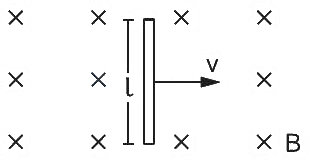
A conducting wire of length , situated perpendicular to a magnetic field , travels with a velocity . As a result of the magnetic force, electrons accumulate at one end, which establishes an electric field within the wire. This redistribution halts once the electric force acting on the free electrons offsets the magnetic force. Determine the electric field established inside the wire once the redistribution ends.
Options
- A
- B
- C
- D
Correct answer
C.
Step-by-step solution
When the conducting wire moves in the magnetic field, the free electrons experience a magnetic Lorentz force.
The magnitude of the magnetic force on an electron of charge is given by:
This force causes electrons to accumulate at one end of the wire, creating an electric field along its length. The electric field exerts an electric force on the electrons in the opposite direction, with magnitude:
In the steady state, the redistribution of electrons stops when the electric force balances the magnetic force:
Substituting the expressions for the forces, we get:
Alternatively, the motional emf developed across the ends of the wire is . The uniform electric field is related to the potential difference by .
Therefore, .