
Concepts Of Physics MCQ Edition [Volume 2]
- Exam
- Concepts Of Physics MCQ Edition [Volume 2]
- Subject
- Physics
- Chapter
- Gauss's Law
Concepts Of Physics MCQ Edition [Volume 2] · Physics · Gauss's Law
As depicted in the figure, a charge q is situated at the centre of...
As depicted in the figure, a charge is situated at the centre of a hemisphere. A second charge is positioned at one of the locations , , , and . For which location(s) of this second charge does the flux of the electric field through the hemisphere remain unchanged?
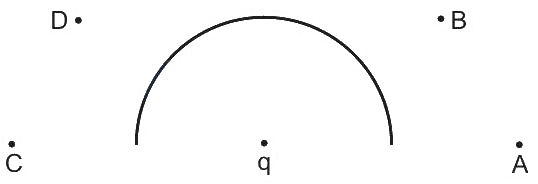
Options
- A
- B
- C
- D
Correct answer
C.
Step-by-step solution
The initial electric flux through the curved surface of the hemisphere due to the charge at the centre is .
When a second charge is placed at any external point, the total flux through the hemisphere becomes , where is the flux due to the charge .
For the total flux to remain unchanged, the flux through the curved surface due to must be zero, i.e., .
Consider a closed surface formed by the curved hemispherical surface and its flat circular base. By Gauss's law, the net flux through this closed surface due to an external charge is zero.
For points and , the charge lies exactly on the plane containing the flat base of the hemisphere. The electric field lines produced by at any point on the base will lie in the plane of the base.
Since the area vector of the base is perpendicular to its plane, the electric field is perpendicular to the area vector everywhere on the base.
Thus, the flux through the base is .
Consequently, for charges placed at and .
For points and , the charge is not in the plane of the base, so field lines will cross the base, making and thus .
Therefore, the flux through the hemisphere remains unchanged only when the second charge is placed at locations and .
Answer: ;