Quantrex Quantrex AcademyJEE · NEET · NDA PYQs with solutions Open app
JEE Main 202624 JanuaryEvening Shift
Exam
JEE Main
Year
2026
Date
24 January
Shift
Evening Shift
Subject
Physics
Chapter
Electrostatics

JEE Main 2026 · 24 January · Evening Shift · Physics · Electrostatics

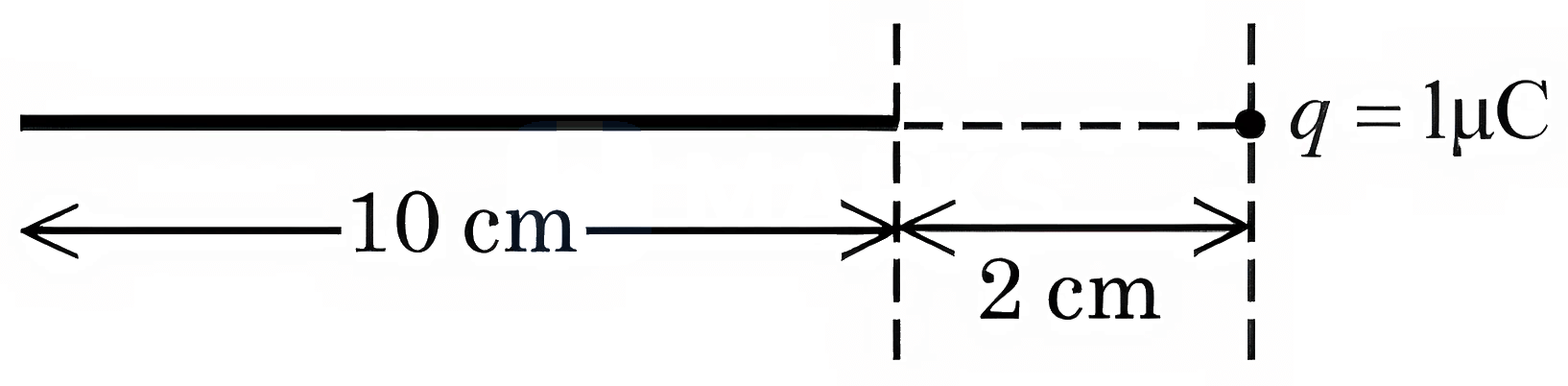
A point charge q=1 μ C is located at a distance 2 cm from one end...

A point charge q=1μCq=1 \mu \mathrm{C} is located at a distance 2 cm from one end of a thin insulating wire of length 10 cm having a charge Q=24μCQ=24 \mu \mathrm{C}, distributed uniformly along its length, as shown in figure. Force between qq and wire is ____\_\_\_\_ N. (Use : 14πϵo=9×10⁹ N.m2/C2\frac{1}{4 \pi \epsilon_{\mathrm{o}}}=9 \times 10^{9} \mathrm{~N}. \mathrm{m}^{2} / \mathrm{C}^{2})
A point charge q=1 μ C is located at a distance 2 cm from one end of a thin insulating wire of length 10 cm having a

Options

  1. ABoth Statement I and Statement II are true
  2. BBoth Statement I and Statement II are false
  3. CStatement I is true but Statement II is false
  4. DStatement I is false but Statement II is true

Correct answer

D. Statement I is false but Statement II is true

Step-by-step solution

Consider a small element of length dxdx on the wire at a distance xx from the point charge qq.
The linear charge density of the wire is λ=QL=24×10−60.1=240×10−6\lambda = \frac{Q}{L} = \frac{24 \times 10^{-6}}{0.1} = 240 \times 10^{-6} C/m.
The charge on the small element is dQ=λdxdQ = \lambda dx.
The electrostatic force between the point charge qq and the element dQdQ is dF=kqdQx2=kqλdxx2dF = \frac{k q dQ}{x^2} = \frac{k q \lambda dx}{x^2}.
The total force FF is obtained by integrating dFdF from x=ax = a to x=a+Lx = a + L, where a=2a = 2 cm and L=10L = 10 cm.
F=∫0.020.12kqλx2dx=kqλ[−1x]0.020.12F = \int_{0.02}^{0.12} \frac{k q \lambda}{x^2} dx = k q \lambda \left[ -\frac{1}{x} \right]_{0.02}^{0.12}
F=kqλ(10.02−10.12)=kqQL(0.12−0.020.02×0.12)F = k q \lambda \left( \frac{1}{0.02} - \frac{1}{0.12} \right) = k q \frac{Q}{L} \left( \frac{0.12 - 0.02}{0.02 \times 0.12} \right)
F=kqQLLa(a+L)=kqQa(a+L)F = \frac{k q Q}{L} \frac{L}{a(a+L)} = \frac{k q Q}{a(a+L)}
Substituting the given values: k=9×10⁹k = 9 \times 10^9 N.m2^2/C2^2, q=1×10⁻⁶q = 1 \times 10^{-6} C, Q=24×10−6Q = 24 \times 10^{-6} C, a=0.02a = 0.02 m, and a+L=0.12a+L = 0.12 m.
F=9×109×1×10−6×24×10−60.02×0.12F = \frac{9 \times 10^9 \times 1 \times 10^{-6} \times 24 \times 10^{-6}}{0.02 \times 0.12}
F=9×24×10−30.0024=216×10−32.4×10−3F = \frac{9 \times 24 \times 10^{-3}}{0.0024} = \frac{216 \times 10^{-3}}{2.4 \times 10^{-3}}
F=2162.4=90F = \frac{216}{2.4} = 90 N.
Practice Electrostatics on Quantrex Academy →

More from Electrostatics

Two charges Q_1 = q and Q_2 = mq are placed at the points P_1(a, b) and P_2(ma, mb)… JEE Advanced 2026Consider an electric dipole comprising two charges +q and -q each with mass m , separated… JEE Advanced 2026Two point charges q_1=3\,μ C and q_2=-4\,μ C are placed at points (2 i +3 j +3 k ) and (… JEE Main 2026The electric potential as a function of x, y is given by V = 5(x^2 - y^2) V. The electric… JEE Main 2026A thin half ring of radius 35 cm is uniformly charged with a total charge of Q coulomb.… JEE Main 2026A three coulomb charge moves from the point (0, -2, -5) to the point (5, 1, 2) in an… JEE Main 2026A particle of charge q and mass m is projected from origin with an initial velocity v = (… JEE Main 2026A rigid dipole undergoes a simple harmonic motion about its centre in the presence of an… JEE Main 2026 Full Electrostatics list All JEE Main PYQs