Quantrex Quantrex AcademyJEE · NEET · NDA PYQs with solutions Open app
JEE Main 202628 JanuaryEvening Shift
Exam
JEE Main
Year
2026
Date
28 January
Shift
Evening Shift
Subject
Physics
Chapter
Ray Optics

JEE Main 2026 · 28 January · Evening Shift · Physics · Ray Optics

A biconvex lens is formed by using two thin planoconvex lenses, as...

A biconvex lens is formed by using two thin planoconvex lenses, as shown in the figure. The refractive index and radius of curved surfaces are also mentioned in figure. When an object is placed on the left side of lens at a distance of 30 cm from the biconvex lens, the magnification of the image will be :
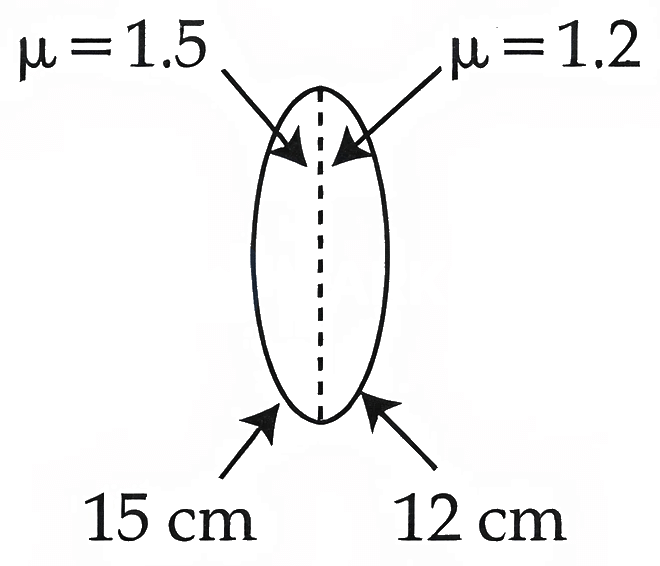
A biconvex lens is formed by using two thin planoconvex lenses, as shown in the figure. The refractive index and radius

Options

  1. A-2
  2. B+2.5
  3. C-2.5
  4. D+2

Correct answer

A. -2

Step-by-step solution

The biconvex lens is a combination of two thin plano-convex lenses in contact.
For the first plano-convex lens: μ1=1.5\mu_1 = 1.5, R1=15R_1 = 15 cm, R2=∞R_2 = \infty.
Using lens maker's formula:
1f1=(μ1−1)(1R1−1R2)\frac{1}{f_1} = (\mu_1 - 1) \left( \frac{1}{R_1} - \frac{1}{R_2} \right)
=(1.5−1)(115−1∞)= (1.5 - 1) \left( \frac{1}{15} - \frac{1}{\infty} \right)
=0.5×115=130= 0.5 \times \frac{1}{15} = \frac{1}{30} cm−1^{-1}.
For the second plano-convex lens:
μ2=1.2\mu_2 = 1.2, R1=∞R_1 = \infty, R2=−12R_2 = -12 cm.
Using lens maker's formula:
1f2=(μ2−1)(1R1−1R2)\frac{1}{f_2} = (\mu_2 - 1) \left( \frac{1}{R_1} - \frac{1}{R_2} \right)
=(1.2−1)(1∞−1−12)= (1.2 - 1) \left( \frac{1}{\infty} - \frac{1}{-12} \right)
=0.2×112=160= 0.2 \times \frac{1}{12} = \frac{1}{60} cm−1^{-1}.
The equivalent focal length FF of the combination is given by:
1F=1f1+1f2=130+160\frac{1}{F} = \frac{1}{f_1} + \frac{1}{f_2} = \frac{1}{30} + \frac{1}{60}
=2+160=360=120= \frac{2+1}{60} = \frac{3}{60} = \frac{1}{20} cm−1^{-1}.
Thus, F=20F = 20 cm.
Given object distance u=−30u = -30 cm. Using the lens formula 1v−1u=1F\frac{1}{v} - \frac{1}{u} = \frac{1}{F}:
1v−1−30=120\frac{1}{v} - \frac{1}{-30} = \frac{1}{20}
⇒1v=120−130=3−260=160\Rightarrow \frac{1}{v} = \frac{1}{20} - \frac{1}{30} = \frac{3-2}{60} = \frac{1}{60}.
So, v=60v = 60 cm.
Magnification m=vu=60−30=−2m = \frac{v}{u} = \frac{60}{-30} = -2.
Practice Ray Optics on Quantrex Academy →

More from Ray Optics

A double convex lens made of glass of refractive index 1.5 and radii of curvature of the… JEE Advanced 2026A beam of polychromatic light passes through a thin prism of prism angle 6^∘ . The… JEE Advanced 2026Consider two isosceles prisms 1 and 2 with prism angles A_1 and A_2 and refractive… JEE Advanced 2026A thin biconvex lens is prepared from the glass ( μ=1.5 ) both curved surfaces of which… JEE Main 2026Light ray incident along a vector AO ( AO = 2 i -3 j ) emerges out along vector OB ( OB =… JEE Main 2026Angle of minimum deviation is equal to the half of the angle of prism in an equilateral… JEE Main 2026A concave mirror of focal length 10 cm forms an image which is double the size of object… JEE Main 2026A spherical interface lens of radius R separates two media of refractive indices 1 and… JEE Main 2026 Full Ray Optics list All JEE Main PYQs