Quantrex Quantrex AcademyJEE · NEET · NDA PYQs with solutions Open app
JEE Main 20204 SeptemberMorning Shift
Exam
JEE Main
Year
2020
Date
4 September
Shift
Morning Shift
Subject
Physics
Chapter
Wave Optics

JEE Main 2020 · 4 September · Morning Shift · Physics · Wave Optics

A beam of plane polarized light of large cross-sectional area and...

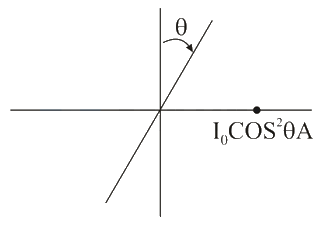
A beam of plane polarized light of large cross-sectional area and uniform intensity of 3.3Wm–23 .3 W{m}^{– 2} falls normally on a polarizer (cross-sectional area 3×10⁻⁴m23 \times {10}^{– 4}{m}^{2}), which rotates about its axis with an angular speed of 31.4rads−131 .4 rad{s}^{- 1}. The energy of light passing through the polarizer per revolution, is close to:A beam of plane polarized light of large cross-sectional area and uniform intensity of 3 .3 W m ^ – 2 falls normally on
Options

  1. A1.0×10−5J1 .0 \times {10}^{- 5}J
  2. B1.0×10−4J1 . 0 \times {10}^{- 4}J
  3. C1.5×10−4J1 . 5 \times {10}^{- 4}J
  4. D5.0×10−4J5 . 0 \times {10}^{- 4}J

Correct answer

B. 1.0×10⁻⁴J1 . 0 \times {10}^{- 4}J

Step-by-step solution

A beam of plane polarized light of large cross-sectional area and uniform intensity of 3 .3 W m ^ – 2 falls normally on

Given,

Intensity of plane polarized light of large cross-sectional area is I0=3.3Wm−2{I}_{0} = 3 . 3W{m}^{- 2}

Area of cross-section of polarizer is A=3×10⁻⁴m2A = 3 \times {10}^{- 4}{m}^{2}

Angular speed of rotation is ω=31.4rads−1\omega = 31 . 4rad{s}^{- 1}

The intensity of light is the given by the definition,

I=EAT...(1)I = \dfrac{E}{AT} . . . ( 1 )

Intensity of light passing through the polarizer as polarizer rotates is given by

Iavg=I01T∫0Tcos⁡2(\omegat)dt{I}_{avg} = {I}_{0}\dfrac{1}{T}{∫}_{0}^{T}\cos^{2}\left(\omegat\right) d t

⇒Iavg=I01T∫0T[1+cos⁡(2\omegat)2]dt⇒ {I}_{avg} = {I}_{0}\dfrac{1}{T}{∫}_{0}^{T}\left[\dfrac{1 + \cos \left(2\omegat\right)}{2}\right] d t

⇒Iavg=I012T[∫0Tdt+∫0Tcos⁡(2\omegat)dt]⇒ {I}_{avg} = {I}_{0}\dfrac{1}{2T}\left[{∫}_{0}^{T} d t + {∫}_{0}^{T}\cos \left(2\omegat\right) d t\right]

⇒Iavg=I012T[T+0]⇒ {I}_{avg} = {I}_{0}\dfrac{1}{2T}\left[T + 0\right]

⇒Iavg=I02...(2)⇒ {I}_{avg} = \dfrac{{I}_{0}}{2} . . . ( 2 )

Using equation (1) and (2) we get energy per revolution is given by

E=I0A2T=I0A22πωE = \dfrac{{I}_{0}A}{2}T = \dfrac{{I}_{0}A}{2}\dfrac{2\pi}{\omega}

E=3.3×3×10−423.1431.4E = \dfrac{3 .3 \times 3 \times {10}^{- 4}}{2}\dfrac{3 . 14}{31 . 4}

E≃1×10⁻⁴JE ≃ 1 \times {10}^{- 4}J

Practice Wave Optics on Quantrex Academy →

More from Wave Optics

In the List-I, four optical effects are mentioned. The physical phenomena of light which… JEE Advanced 2026In a single slit diffraction experiment, a slit of width (0.016 ± 0.002) mm is used to… JEE Advanced 2026As shown in the figure, a ray AB of unpolarized light enters from water of refractive… JEE Advanced 2026Some distant star is to be observed by some telescope of diameter of objective lens a… JEE Main 2026In a Young double slit experiment, the wavelength of incident light is 6000 Å, the… JEE Main 2026In interference experiment the path difference between two interfering waves at a point A… JEE Main 2026An unpolarized light of intensity I_o passes through polarizer and then through a certain… JEE Main 2026The maximum intensity in a Young's double slit experiment is I_0 . Distance between the… JEE Main 2026 Full Wave Optics list All JEE Main PYQs