Quantrex Quantrex AcademyJEE · NEET · NDA PYQs with solutions Open app
NEET
Exam
NEET
Subject
Physics
Chapter
Laws of Motion

NEET · Physics · Laws of Motion

On a pulley of mass M hangs a rope with two masses m_ 1 and m_ 2...

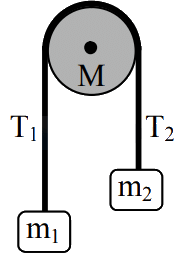
On a pulley of mass M hangs a rope with two masses m1\mathrm{m}_{1} and \mathrm{m}_{2}\left(\mathrm{~m}_{1}>\mathrm{m}_{2}\right) tied at the ends as shown in the figure. The pulley rotates without any friction, whereas the friction between the rope and the pulley is large enough to prevent any slipping. Which of the following plots best represents the difference between the tensions in the rope on the two sides of the pulley as a function of the mass of the pulley? On a pulley of mass M hangs a rope with two masses m_ 1 and m_ 2 (~m_ 1 >m_ 2 ) tied at the ends as shown in the
Options

  1. AWhich of the following is correct regarding AIDS causative agent HIV?
  2. BWhich of the following is correct regarding AIDS causative agent HIV?
  3. CWhich of the following is correct regarding AIDS causative agent HIV?
  4. DWhich of the following is correct regarding AIDS causative agent HIV?

Correct answer

C. Which of the following is correct regarding AIDS causative agent HIV?

Step-by-step solution

On a pulley of mass M hangs a rope with two masses m_ 1 and m_ 2 (~m_ 1 >m_ 2 ) tied at the ends as shown in the
mg−T1=m1a......(1)\mathrm{mg}-\mathrm{T}_{1}=\mathrm{m}_{1} \mathrm{a}......\mathrm{(1)} T2−m2 g=m2a......(2)\mathrm{T}_{2}-\mathrm{m}_{2} \mathrm{~g}=\mathrm{m}_{2} \mathrm{a}......\mathrm{(2)} (T1−T2)×R=Iα[∵a=rα]=IaR(1)+(2)(m1−m2)g+(T2−T1)=(m1+m2)a(T1−T2)=IR2[(m1−m2)g+(T2−T1)m1+m2]⇒(T1−T2)[1+Ik2( m1+m2)]=Ik2(m1−m2)m1+m2 g⇒T1−T2=[I(m1−m2)gI+(m1+m2)R2]=12MR2( m1−m2)g(12MR2+(m1+m2)R2)T1−T2=M(m1−m2)gM+2( m1+m2)\begin{array}{l} \left(\mathrm{T}_{1}-\mathrm{T}_{2}\right) \times \mathrm{R}=\mathrm{I} \alpha \quad[\because \mathrm{a}=\mathrm{r} \alpha] \\ =\frac{\mathrm{Ia}}{\mathrm{R}} \\ (1)+(2) \\ \left(\mathrm{m}_{1}-\mathrm{m}_{2}\right) \mathrm{g}+\left(\mathrm{T}_{2}-\mathrm{T}_{1}\right)=\left(\mathrm{m}_{1}+\mathrm{m}_{2}\right) \mathrm{a} \\ \left(\mathrm{T}_{1}-\mathrm{T}_{2}\right)=\frac{\mathrm{I}}{\mathrm{R}^{2}}\left[\frac{\left(\mathrm{m}_{1}-\mathrm{m}_{2}\right) \mathrm{g}+\left(\mathrm{T}_{2}-\mathrm{T}_{1}\right)}{\mathrm{m}_{1}+\mathrm{m}_{2}}\right] \\ \Rightarrow\left(\mathrm{T}_{1}-\mathrm{T}_{2}\right)\left[1+\frac{\mathrm{I}}{\mathrm{k}^{2}\left(\mathrm{~m}_{1}+\mathrm{m}_{2}\right)}\right] \\ =\frac{\mathrm{I}}{\mathrm{k}^{2}} \frac{\left(\mathrm{m}_{1}-\mathrm{m}_{2}\right)}{\mathrm{m}_{1}+\mathrm{m}_{2}} \mathrm{~g} \\ \Rightarrow \mathrm{T}_{1}-\mathrm{T}_{2}=\left[\frac{\mathrm{I}\left(\mathrm{m}_{1}-\mathrm{m}_{2}\right) \mathrm{g}}{\mathrm{I}+\left(\mathrm{m}_{1}+\mathrm{m}_{2}\right) \mathrm{R}^{2}}\right] \\ =\frac{\frac{1}{2} \mathrm{MR}^{2}\left(\mathrm{~m}_{1}-\mathrm{m}_{2}\right) \mathrm{g}}{\left(\frac{1}{2} \mathrm{MR}^{2}+\left(\mathrm{m}_{1}+\mathrm{m}_{2}\right) \mathrm{R}^{2}\right)} \\ \mathrm{T}_{1}-\mathrm{T}_{2}=\frac{\mathrm{M}\left(\mathrm{m}_{1}-\mathrm{m}_{2}\right) \mathrm{g}}{\mathrm{M}+2\left(\mathrm{~m}_{1}+\mathrm{m}_{2}\right)} \end{array}
Practice Laws of Motion on Quantrex Academy →

More from Laws of Motion

The magnitude and direction of the acceleration produced in a body of mass 5 kg when two… NEET 2026A box of mass 15 kg is kept on the floor of a stationary trolley. The coefficient of… NEET 2026A car travels on a circular racetrack of radius 50 m, which is banked at an angle θ . If… NEET 2026There are two inclined surface of equal length (L) and same angle of inclination 45^ ∘… NEET 2025A uniform rod of mass 20 kg and length 5 m leans against a smooth vertical wall making an… NEET 2025A box of mass 5 kg is pulled by a cord, up along a frictionless plane inclined at 30^ ∘… NEET 2024A bob is whirled in a horizontal circle by means of a string at an initial speed of 10… NEET 2024A horizontal force 10 N is applied to a block A as shown in figure. The mass of blocks A… NEET 2024 Full Laws of Motion list All NEET PYQs