
NEET
- Exam
- NEET
- Subject
- Physics
- Chapter
- Wave Optics
NEET · Physics · Wave Optics
Unpolarised light from air incidents on the surface of a...
Unpolarised light from air incidents on the surface of a transparent medium of refractive index 1.414 such that the reflected light is completely polarised. Match the angles given in List-I with the corresponding values given in List-II.
The correct match is
Codes
Options
- A(ii) (iii) (i) (iv)
- B(ii) (iii) (iv) (i)
- C(iv) (i) (iii) (ii)
- D(iv) (iii) (i) (ii)
Correct answer
D. (iv) (iii) (i) (ii)
Step-by-step solution
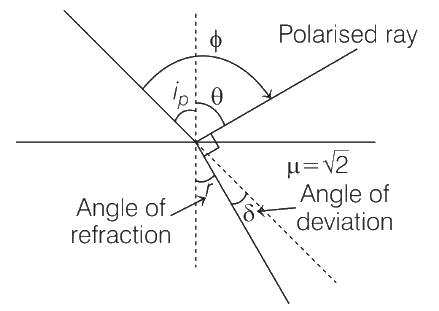
Figure showing the ray diagram of refraction at a plane surface.
Given, angle of polarisation
So, From Snell's law, Here, \begin{aligned} & \delta=i_p-r \\ & \delta=\sin ^{-1} \sqrt{\frac{2}{3}}-\sin ^{-1} \frac{1}{\sqrt{3}} \end{aligned}Angle of reflection, $\begin{gathered} \theta=90^{\circ}-r \Rightarrow r=90^{\circ}-\theta \\ \sin ^{-1} \frac{1}{\sqrt{3}}=90^{\circ}-\theta \Rightarrow \frac{1}{\sqrt{3}}=\sin \left(90^{\circ}-\theta\right) \\ \cos \theta=\frac{1}{\sqrt{3}} \Rightarrow \theta=\cos ^{-1} \frac{1}{\sqrt{3}} \end{gathered}$ Angle between incident and completely polarised light is given by\begin{aligned} & \phi=i_p+\theta \\ & \phi=\sin ^{-1} \sqrt{\frac{2}{3}}+\cos ^{-1}\left(\frac{1}{\sqrt{3}}\right)=2 \sin ^{-1} \sqrt{\frac{2}{3}} \end{aligned}$$ Hence, the correct option is (d).
So, From Snell's law, Here, \begin{aligned} & \delta=i_p-r \\ & \delta=\sin ^{-1} \sqrt{\frac{2}{3}}-\sin ^{-1} \frac{1}{\sqrt{3}} \end{aligned}Angle of reflection, $\begin{gathered} \theta=90^{\circ}-r \Rightarrow r=90^{\circ}-\theta \\ \sin ^{-1} \frac{1}{\sqrt{3}}=90^{\circ}-\theta \Rightarrow \frac{1}{\sqrt{3}}=\sin \left(90^{\circ}-\theta\right) \\ \cos \theta=\frac{1}{\sqrt{3}} \Rightarrow \theta=\cos ^{-1} \frac{1}{\sqrt{3}} \end{gathered}$ Angle between incident and completely polarised light is given by\begin{aligned} & \phi=i_p+\theta \\ & \phi=\sin ^{-1} \sqrt{\frac{2}{3}}+\cos ^{-1}\left(\frac{1}{\sqrt{3}}\right)=2 \sin ^{-1} \sqrt{\frac{2}{3}} \end{aligned}$$ Hence, the correct option is (d).