Quantrex Quantrex AcademyJEE · NEET · NDA PYQs with solutions Open app
NEET
Exam
NEET
Subject
Physics
Chapter
Dual Nature of Matter

NEET · Physics · Dual Nature of Matter

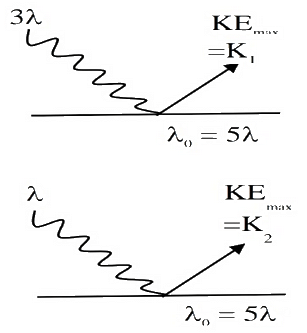
On a photositive surface of threshold wavelength (5 λ), two...

On a photositive surface of threshold wavelength (5 \lambda), two different monochromatic beams of wavelengths (3 \lambda) and (\lambda) are incident, one after another, then match the ratio of physical quantities specified in column - I to the ratio values given in column - II. (
Column IColumn II
(a)Maximum KE of photo electrons(i)1 : 3
(b)Speed of incident photons(ii)1 : 6
(c)Momentum of incident photons(iii)1 : \sqrt{6}
(d)Fastest speeds of photo electrons(iv)1 : 1
) Choose the correct answer from the option given below:On a photositive surface of threshold wavelength (5 λ), two different monochromatic beams of wavelengths (3 λ) and (λ)
Options

  1. A(a) - iii, (b) - ii, (c) - i, (d) - iv
  2. B(a) - ii, (b) - iv, (c) - iii, (d) - i
  3. C(a) - ii, (b) - iv, (c) - i, (d) - iii
  4. D(a) - i, (b) - ii, (c) - iv, (d) - iii

Correct answer

C. (a) - ii, (b) - iv, (c) - i, (d) - iii

Step-by-step solution

On a photositive surface of threshold wavelength (5 λ), two different monochromatic beams of wavelengths (3 λ) and (λ)
K1=hc3λ−hc5λ=hcλ[13−15]=hcλ[215]K2=hcλ−hc5λ=hcλ[1−15]=hcλ[45]\begin{aligned} & \mathrm{K}_1=\frac{\mathrm{hc}}{3 \lambda}-\frac{\mathrm{hc}}{5 \lambda}=\frac{\mathrm{hc}}{\lambda}\left[\frac{1}{3}-\frac{1}{5}\right]=\frac{\mathrm{hc}}{\lambda}\left[\frac{2}{15}\right] \\ & \mathrm{K}_2=\frac{\mathrm{hc}}{\lambda}-\frac{\mathrm{hc}}{5 \lambda}=\frac{\mathrm{hc}}{\lambda}\left[1-\frac{1}{5}\right]=\frac{\mathrm{hc}}{\lambda}\left[\frac{4}{5}\right] \end{aligned}) (a) RatioofofKE (\frac{\mathrm{K}_1}{\mathrm{~K}_2}=\frac{\frac{\mathrm{hc}}{\lambda}\left[\frac{2}{15}\right]}{\frac{\mathrm{hc}}{\lambda}\left[\frac{4}{5}\right]}=\frac{1}{6}=1: 6) (b) Ratio of speeds of incident photons (\frac{c_1}{c_2}=\frac{1}{1}=1: 1) Ratio of momentum of incident photons (\frac{\mathrm{p}_1}{\mathrm{p}_2}=\frac{\lambda_2}{\lambda_1}=\frac{\lambda}{3 \lambda}=1: 3) (c) Ratio of fastest speed of photo electrons (\frac{v_1}{v_2}=\sqrt{\frac{K_1}{K_2}}=\sqrt{\frac{1}{6}}=1: \sqrt{6})$
Practice Dual Nature of Matter on Quantrex Academy →

More from Dual Nature of Matter

An electron and positron are accelerated from rest to the same kinetic energy. The ratio… MHT CET Medical 2026An electron of mass m and charge e initially at rest gets accelerated by a constant… MHT CET Medical 2026The wavelength λ_e of an electron and λ_P of a photon of same energy E are related as MHT CET Medical 2026A light of wavelength λ(λ < λ_0) falls on a metal surface. The momentum of the fastest… MHT CET Medical 2026The de Broglie wavelength of an electron with kinetic energy K_1 is λ_1 . If the kinetic… MHT CET Medical 2026A student plots two different graphs using the same photoelectric experiment data. 1.… MHT CET Medical 2026In a photoelectric cell, for the incident radiation of wavelength λ , the fastest… MHT CET Medical 2026A particle is dropped from a height ' y '. The de-Broglie wavelength of the particle as a… MHT CET Medical 2026 Full Dual Nature of Matter list All NEET PYQs