
JEE Advanced 2006
- Exam
- JEE Advanced
- Year
- 2006
- Subject
- Chemistry
- Chapter
- Haloalkanes and Haloarenes
JEE Advanced 2006 · Chemistry · Haloalkanes and Haloarenes
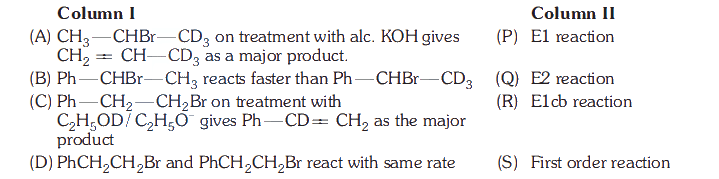
Match the following
Match the following
Options
- A(A) Q, (B) P, (C) R,S, (D) Q,S
- B(A) S, (B) R, (C) R, (D) P,S
- C(A) R, (B) Q, (C) S, (D) Q,S
- D(A) Q, (B) Q, (C) R,S, (D) P,S
Correct answer
D. (A) Q, (B) Q, (C) R,S, (D) P,S
Step-by-step solution
The formation of can be explained on the basis of the fact that bond is much stronger than bond. (B) match with (Q) Reactivity of is greater than because bond is more stronger than bond.
In the step (II), a slow unimolecular elimination occurs in the conjugate base of the reactant and hence this mechanism is called or carbanion mechanism. Since step (I) must be reversible, if ethanol containing is used as solvent, it would be expected that the original bromide would incorporate deuterium (D). Step I. Step II. \mathrm{CH}=\mathrm{CH} Rate Similarly Step II. \mathrm{PhCD}=\mathrm{CHD} Rate Hence, reaction and first order kinetics.