Quantrex Quantrex AcademyJEE · NEET · NDA PYQs with solutions Open app
JEE Advanced 2026Paper 2
Exam
JEE Advanced
Year
2026
Paper
Paper 2
Subject
Physics
Chapter
Capacitance

JEE Advanced 2026 · Paper 2 · Physics · Capacitance

Passage: A container of height 2 m, length 2 m and breadth 1 m is...

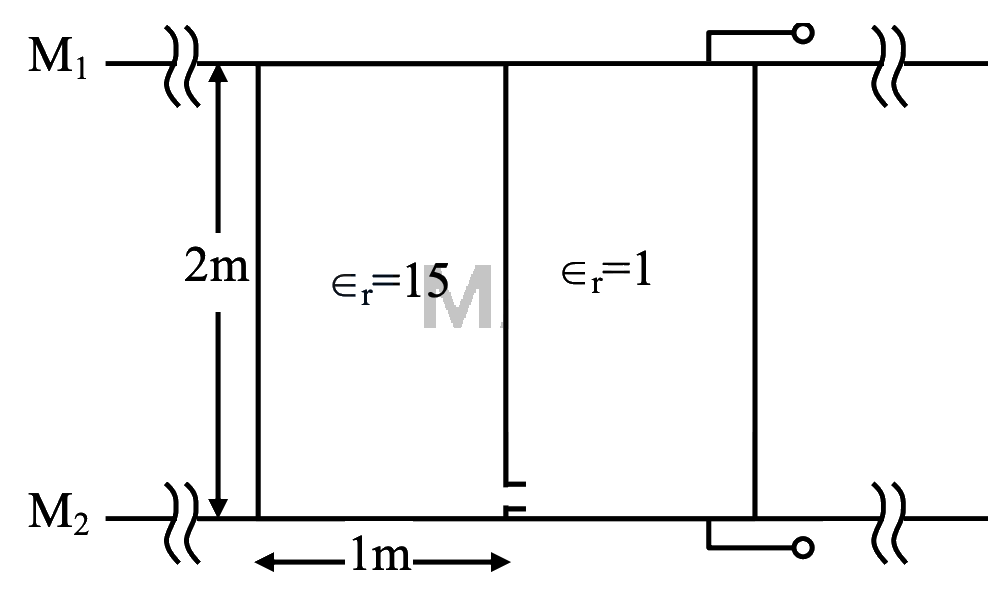
Passage: A container of height 22 m, length 22 m and breadth 11 m is made of insulating vertical walls and two large area horizontal metal plates (M1M_1 and M2M_2) which extend far beyond the vertical walls in all directions. The container is partitioned into two equal chambers with a thin insulating vertical wall. The partition wall contains a small hole of cross-sectional area 10\sqrt{10} cm2^2 near its bottom edge. Initially the hole is closed and the left chamber of the container is completely filled with a liquid of dielectric constant ϵr=15\epsilon_r = 15 and the right chamber is empty (ϵr=1\epsilon_r = 1). At time t=0t = 0, the hole is opened and the liquid flows from the left chamber to the right chamber. In both the chambers, the space above the liquid has ϵr=1\epsilon_r = 1 and is maintained at atmospheric pressure. The schematic of the container at a time t>0t > 0 is shown in the figure.
[Given: acceleration due to gravity is 1010 ms−2^{-2}.]
Passage: A container of height 2 m, length 2 m and breadth 1 m is made of insulating vertical walls and two large area

Question: The difference in the capacitance (in F) between the metal plates at t=0t = 0 and that at t=500t = 500 s is (8−n)ϵ0(8 - n)\epsilon_0, where ϵ0\epsilon_0 is the permittivity of free space. The value of nn is:

Correct answer

0

Step-by-step solution

Let AA be the area of each chamber. A=1×1=1 m2A = 1 \times 1 = 1 \text{ m}^2. Distance between plates is d=2 md = 2 \text{ m}.

At t=0t = 0, the left chamber is completely filled with liquid (ϵr=15\epsilon_r = 15) and right chamber is empty (ϵr=1\epsilon_r = 1).

Initial capacitance C(0)=C1+C2=15ϵ0Ad+ϵ0Ad=15ϵ0(1)2+ϵ0(1)2=8ϵ0C(0) = C_1 + C_2 = \dfrac{15 \epsilon_0 A}{d} + \dfrac{\epsilon_0 A}{d} = \dfrac{15 \epsilon_0 (1)}{2} + \dfrac{\epsilon_0 (1)}{2} = 8 \epsilon_0.

Let y1y_1 and y2y_2 be the liquid levels in the left and right chambers at time tt. By conservation of volume, y1+y2=2 my_1 + y_2 = 2 \text{ m}.

Let h=y1−y2h = y_1 - y_2. The velocity of efflux from the left chamber is v=2ghv = \sqrt{2gh}.

Rate of flow Q=−Ady1dt=a2ghQ = -A \dfrac{dy_1}{dt} = a \sqrt{2gh}, where a=10×10−4 m2a = \sqrt{10} \times 10^{-4} \text{ m}^2 is the hole area.

Since y1+y2=2y_1 + y_2 = 2, we have dy2=−dy1dy_2 = -dy_1, so dh=2dy1⇒dy1dt=12dhdtdh = 2dy_1 \Rightarrow \dfrac{dy_1}{dt} = \dfrac{1}{2} \dfrac{dh}{dt}.

−12dhdt=a2gh⇒dhh=−2a2gdt-\dfrac{1}{2} \dfrac{dh}{dt} = a \sqrt{2gh} \Rightarrow \dfrac{dh}{\sqrt{h}} = -2a \sqrt{2g} dt.

Integrating from t=0t=0 (h=2h=2) to t=500 st=500 \text{ s} (hh):

∫2hh−1/2dh=−2a2g∫0500dt\int_{2}^{h} h^{-1/2} dh = -2a \sqrt{2g} \int_{0}^{500} dt

2h−22=−2(10×10−4)(20)(500)=−200×10−4×1000=−102×0.1=−22\sqrt{h} - 2\sqrt{2} = -2 (\sqrt{10} \times 10^{-4}) (\sqrt{20}) (500) = -\sqrt{200} \times 10^{-4} \times 1000 = -10\sqrt{2} \times 0.1 = -\sqrt{2}.

2h=2⇒h=12⇒h=0.5 m2\sqrt{h} = \sqrt{2} \Rightarrow \sqrt{h} = \dfrac{1}{\sqrt{2}} \Rightarrow h = 0.5 \text{ m}.

From y1+y2=2y_1 + y_2 = 2 and y1−y2=0.5y_1 - y_2 = 0.5, we get y1=1.25 my_1 = 1.25 \text{ m} and y2=0.75 my_2 = 0.75 \text{ m}.

At t=500 st=500 \text{ s}, each chamber acts as two capacitors in series (liquid and air).

Cleft=1y115ϵ0A+2−y1ϵ0A=15ϵ030−14y1=15ϵ030−14(1.25)=15ϵ012.5=65ϵ0=1.2ϵ0C_{left} = \dfrac{1}{\dfrac{y_1}{15\epsilon_0 A} + \dfrac{2-y_1}{\epsilon_0 A}} = \dfrac{15\epsilon_0}{30 - 14y_1} = \dfrac{15\epsilon_0}{30 - 14(1.25)} = \dfrac{15\epsilon_0}{12.5} = \dfrac{6}{5} \epsilon_0 = 1.2 \epsilon_0.

Cright=1y215ϵ0A+2−y2ϵ0A=15ϵ030−14y2=15ϵ030−14(0.75)=15ϵ019.5=150195ϵ0=1013ϵ0C_{right} = \dfrac{1}{\dfrac{y_2}{15\epsilon_0 A} + \dfrac{2-y_2}{\epsilon_0 A}} = \dfrac{15\epsilon_0}{30 - 14y_2} = \dfrac{15\epsilon_0}{30 - 14(0.75)} = \dfrac{15\epsilon_0}{19.5} = \dfrac{150}{195} \epsilon_0 = \dfrac{10}{13} \epsilon_0.

C(500)=Cleft+Cright=65ϵ0+1013ϵ0=12865ϵ0≈1.97ϵ0C(500) = C_{left} + C_{right} = \dfrac{6}{5} \epsilon_0 + \dfrac{10}{13} \epsilon_0 = \dfrac{128}{65} \epsilon_0 \approx 1.97 \epsilon_0.

Difference in capacitance =C(0)−C(500)=8ϵ0−12865ϵ0=(8−12865)ϵ0= C(0) - C(500) = 8\epsilon_0 - \dfrac{128}{65}\epsilon_0 = \left(8 - \dfrac{128}{65}\right)\epsilon_0.

Comparing this with the given expression (8−n)ϵ0(8 - n)\epsilon_0, we get n=12865=1.97n = \dfrac{128}{65} = 1.97
Practice Capacitance on Quantrex Academy →

More from Capacitance

A parallel plate capacitor is having separation between plates 0.885 mm. It has a… JEE Main 2026A sphere of capacitance 100 pF is charged to a potential of 100 V. Another identical… JEE Main 2026From the circuit given below, the capacitance between terminals A and B shown in the… JEE Main 2026A parallel plate air capacitor is connected to a battery. The plates are pulled apart at… JEE Main 2026Consider a circuit consisting of a capacitor ( 20\ μ F), resistor ( 100\ Ω ) and two… JEE Main 2026The dimensional formula of (1)/(2)ε_0 E^2 ( ε_0 = permittivity of vacuum and E = electric… JEE Main 2026A parallel plate air capacitor has a capacitance C . When it is half filled as show in… JEE Main 2026Identify the correct statements : A. Effective capacitance of a series combination of… JEE Main 2026 Full Capacitance list All JEE Advanced PYQs