Quantrex Quantrex AcademyJEE · NEET · NDA PYQs with solutions Open app
JEE Advanced 2010Paper 1
Exam
JEE Advanced
Year
2010
Paper
Paper 1
Subject
Physics
Chapter
Center of Mass, Momentum and Collision

JEE Advanced 2010 · Paper 1 · Physics · Center of Mass, Momentum and Collision

A point mass of 1 ~kg collides elastically with a stationary point...

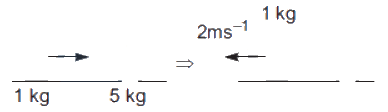
A point mass of 1 kg1 \mathrm{~kg} collides elastically with a stationary point mass of 5 kg5 \mathrm{~kg}. After their collision, the 1 kg1 \mathrm{~kg} mass reverses its direction and moves with a speed of 2 ms−12 \mathrm{~ms}^{-1}. Which of the following statement(s) is/are correct for the system of these two masses?A point mass of 1 ~kg collides elastically with a stationary point mass of 5 ~kg . After their collision, the 1 ~kgA point mass of 1 ~kg collides elastically with a stationary point mass of 5 ~kg . After their collision, the 1 ~kg

Options

  1. ATotal momentum of the system is 3 kg−ms−13 \mathrm{~kg}-\mathrm{ms}^{-1}
  2. BMomentum of 5 kg5 \mathrm{~kg} mass after collision is 4 kg−ms−14 \mathrm{~kg}-\mathrm{ms}^{-1}
  3. CKinetic energy of the centre of mass is 0.75 J0.75 \mathrm{~J}
  4. DTotal kinetic energy of the system is 4 J4 \mathrm{~J}

Correct answer

A. Total momentum of the system is 3 kg−ms−13 \mathrm{~kg}-\mathrm{ms}^{-1}

Step-by-step solution

A point mass of 1 ~kg collides elastically with a stationary point mass of 5 ~kg . After their collision, the 1 ~kg
v1′=(m1−m5m1+m5)v1+(2m5m1+m5)v5−2=(1−51+5)v1+0( as )v5=0)∴v1=3 ms−1v5′=(m5−m1m1+m5)v5+(2m1m1+m2)v1=0+(2×16)(3)=1 ms−1PCM=Pi=(1)(3)=3kg−msP5′=(5)(1)=5kg−m5KCM=PCM22MCM=92×6=0.75 JKtotal =12×1×(3)2=4.5 J\begin{aligned}& v_1^{\prime}=\left(\frac{m_1-m_5}{m_1+m_5}\right)v_1+\left(\frac{2 m_5}{m_1+m_5}\right)v_5 \\ & -2=\left(\frac{1-5}{1+5}\right)v_1+0 \quad\left(\text{ as })v_5=0\right) \\ & \therefore \quad v_1=3 \mathrm{~ms}^{-1}\\ & v_5^{\prime}=\left(\frac{m_5-m_1}{m_1+m_5}\right)v_5+\left(\frac{2 m_1}{m_1+m_2}\right)v_1 \\ & =0+\left(\frac{2 \times 1}{6}\right)(3)=1 \mathrm{~ms}^{-1}\\ & P_{\mathrm{CM}}=P_i=(1)(3) \\ & =3 \frac{\mathrm{kg}-\mathrm{m}}{\mathrm{s}}\\ & P_5{ }^{\prime}=(5)(1)=5 \frac{\mathrm{kg}-\mathrm{m}}{5}\\ & K_{\mathrm{CM}}=\frac{P_{\mathrm{CM}}^2}{2 M_{\mathrm{CM}}}\\ & =\frac{9}{2 \times 6}=0.75 \mathrm{~J}\\ & K_{\text{total }}=\frac{1}{2} \times1 \times(3)^2 \\ & =4.5 \mathrm{~J}\\ & \end{aligned}\therefore$ correct options are (a) and (c).
Practice Center of Mass, Momentum and Collision on Quantrex Academy →

More from Center of Mass, Momentum and Collision

Two identical bodies A and B of equal masses have initial velocities v_1 = 4 i m/s and… JEE Main 2026The position of center of mass of three masses 2 kg, 3 kg and 15 kg placed with respect… JEE Main 2026Two blocks of masses 2 kg and 1 kg respectively, are tied to the ends of a string which… JEE Main 2026The position of an object having mass 0.1 kg as a function of time t is given as r =… JEE Main 2026A body of mass 14 kg initially at rest explodes and breaks into three fragments of masses… JEE Main 2026In a perfectly inelastic collision, two spheres made of the same material with masses 15… JEE Main 2026Given below are two statements : Statement I : For a mechanical system of many particles… JEE Main 2026In a scattering experiment, a particle of mass 2 m collides with another particle of mass… JEE Advanced 2025 Full Center of Mass, Momentum and Collision list All JEE Advanced PYQs