
JEE Advanced 2026Paper 1
- Exam
- JEE Advanced
- Year
- 2026
- Paper
- Paper 1
- Subject
- Physics
- Chapter
- Rotational Motion
JEE Advanced 2026 · Paper 1 · Physics · Rotational Motion
Consider a large disk of radius R and two smaller disks, each of...
Consider a large disk of radius and two smaller disks, each of radius , lying on its circumference, as shown in the figure. The smaller disks are initially in contact with each other, with an angular separation between their centers. They are made to roll without slipping in opposite directions, with constant angular velocities and while the large disk is held stationary. The time at which the smaller disks are again in contact is:
[Use and ignore gravity.]
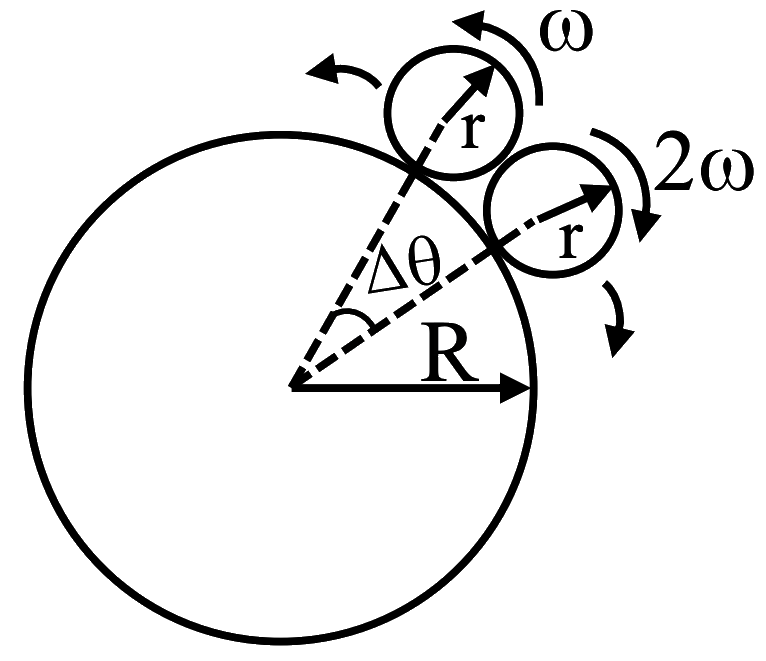
[Use and ignore gravity.]
Options
- A
- B
- C
- D
Correct answer
C.
Step-by-step solution
Let the radius of the large disk be and the radius of the small disks be . We are given , which implies .
The centers of the small disks move along a circular path of radius .
When the two small disks are in contact, the distance between their centers is . The angular separation between their centers is given by the arc length (which is approximately the chord length for small angles):
The small disks roll without slipping on the stationary large disk. For a disk of radius rolling with angular velocity , the velocity of its center is .
The angular velocity of the center of the first small disk about the center of the large disk is:
Similarly, for the second small disk rolling with angular velocity , the angular velocity of its center is:
Since they move in opposite directions, their relative angular velocity is:
The disks are initially in contact, meaning their centers are separated by an angle . They will be in contact again when their centers are once again separated by after crossing each other on the opposite side of the large disk.
The total angular distance that the two centers must cover together is:
Substituting :
The time taken for them to meet again is:
Answer: