
JEE Advanced 2026Paper 2
- Exam
- JEE Advanced
- Year
- 2026
- Paper
- Paper 2
- Subject
- Physics
- Chapter
- Rotational Motion
JEE Advanced 2026 · Paper 2 · Physics · Rotational Motion
Passage: A uniform circular disk of radius 0.2 m and mass 1 kg is...
Passage: A uniform circular disk of radius m and mass kg is pivoted at its top point such that it can rotate freely around in the plane, as shown in the figure. Initially, when the disk is at rest, a particle of mass g, travelling along negative direction in the plane with speed ms, hits the circumference of the disk at a point . After collision the particle moves along negative direction at a speed of ms.
[Given: the acceleration due to gravity ms]
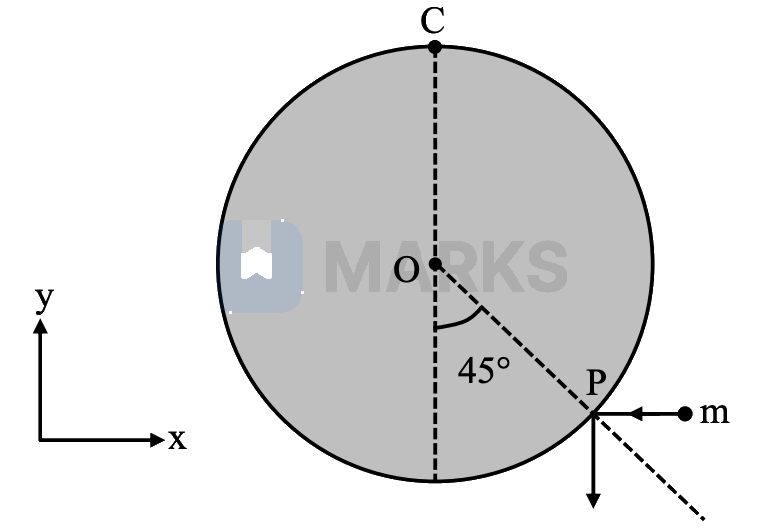
Question: Amount of energy loss (in J) in the collision is:
[Given: the acceleration due to gravity ms]
Question: Amount of energy loss (in J) in the collision is:
Correct answer
17.47
Step-by-step solution
Let the center of the uniform circular disk be the origin . The disk is pivoted at its top point .
Radius of disk m, Mass kg.
Mass of particle g = kg.
Initial velocity of particle ms.
Final velocity of particle ms.
The particle hits the disk at point . From the figure, the line makes an angle of PO(R\sin 45^{\circ}, -R\cos 45^{\circ})PC\vec{r}_{P/C} = (R\sin 45^{\circ} - 0)\hat{i} + (-R\cos 45^{\circ} - R)\hat{j} = \dfrac{R}{\sqrt{2}}\hat{i} - R\left(1 + \dfrac{1}{\sqrt{2}}\right)\hat{j}CC\vec{L}_i = \vec{r}_{P/C} \times (m\vec{v}_i) = \left[ \dfrac{R}{\sqrt{2}}\hat{i} - R\left(1 + \dfrac{1}{\sqrt{2}}\right)\hat{j} \right] \times (-100m\hat{i})\vec{L}_i = -100mR\left(1 + \dfrac{1}{\sqrt{2}}\right)(\hat{j} \times \hat{i}) = -100mR\left(1 + \dfrac{1}{\sqrt{2}}\right)\hat{k}m = 0.02R = 0.2\vec{L}_i = -100(0.02)(0.2) kg ms
Final angular momentum of the particle about :
kg ms
Let be the angular velocity of the disk after collision. Its moment of inertia about is:
kg m
Final angular momentum of the disk is
By conservation of angular momentum about :
rad s
Initial kinetic energy of the system:
J
Final kinetic energy of the system:
Amount of energy loss:
Using ,
J