
JEE Advanced 2026Paper 1
- Exam
- JEE Advanced
- Year
- 2026
- Paper
- Paper 1
- Subject
- Physics
- Chapter
- Thermal Properties of Matter
JEE Advanced 2026 · Paper 1 · Physics · Thermal Properties of Matter
As shown in the figure, an insulated container is fitted with a...
As shown in the figure, an insulated container is fitted with a thermally conducting but immovable partition and a freely movable but thermally insulated piston . The partition with thermal conductivity , cross sectional area and width divides the container into two sections, and , each containing one mole of a monoatomic gas. The piston moves freely such that the gas in is always at the atmospheric pressure. Initially, the difference between the temperatures of and is . The time it takes for the temperature difference to become is , where is the universal gas constant. The value of is:
[Given: ]
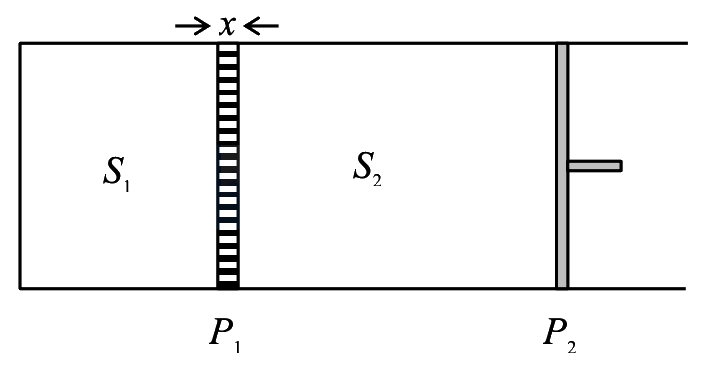
[Given: ]
Correct answer
0
Step-by-step solution
Let and be the temperatures of the gases in sections and respectively. Assume , so heat flows from to .
The rate of heat transfer through the partition is given by Fourier's law of heat conduction:
For section , the volume is constant (since is immovable). Thus, the process is isochoric. The heat lost by is:
Since the gas is monoatomic and mole, .
For section , the pressure is constant (since is freely movable and exposed to atmospheric pressure). Thus, the process is isobaric. The heat gained by is:
Since the gas is monoatomic and mole, .
The change in the temperature difference is:
Substituting the rate of heat transfer into the equation:
Let . The differential equation becomes:
Integrating both sides from to , where the temperature difference goes from to :
Given that :
Comparing this with the given expression , we get:
Answer: