Quantrex Quantrex AcademyJEE · NEET · NDA PYQs with solutions Open app
JEE Advanced 2026Paper 1
Exam
JEE Advanced
Year
2026
Paper
Paper 1
Subject
Physics
Chapter
Thermodynamics

JEE Advanced 2026 · Paper 1 · Physics · Thermodynamics

As shown in the figure, five Carnot engines, each with efficiency...

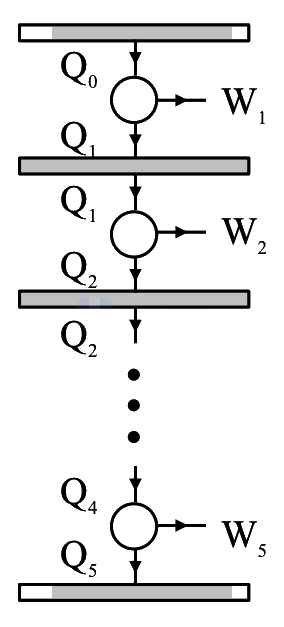
As shown in the figure, five Carnot engines, each with efficiency η\eta and same number of cycles per unit time, are operating between six heat reservoirs. The amount of heat released per cycle by one engine is completely absorbed by the next engine. Consider Q0Q_0 to be the amount of heat absorbed per cycle by the first engine and WW as the amount of total work done by all the engines per cycle, then the net efficiency of the system is found to be ηnet=WQ0=211243\eta_{\text{net}} = \dfrac{W}{Q_0} = \dfrac{211}{243}. The value of η\eta is:
As shown in the figure, five Carnot engines, each with efficiency and same number of cycles per unit time, are

Correct answer

0

Step-by-step solution

Let Q0Q_0 be the heat absorbed by the first engine and Q1Q_1 be the heat rejected.

The efficiency of the first engine is η=1−Q1Q0⇒Q1=Q0(1−η)\eta = 1 - \dfrac{Q_1}{Q_0} \Rightarrow Q_1 = Q_0(1 - \eta)

Similarly, for the second engine, the heat rejected is Q2=Q1(1−η)=Q0(1−η)2Q_2 = Q_1(1 - \eta) = Q_0(1 - \eta)^2

Following this pattern, for the 5th5^{\text{th}} engine, the heat rejected is Q5=Q0(1−η)5Q_5 = Q_0(1 - \eta)^5

The total work done by all five engines is W=W1+W2+W3+W4+W5=(Q0−Q1)+(Q1−Q2)+⋯+(Q4−Q5)=Q0−Q5W = W_1 + W_2 + W_3 + W_4 + W_5 = (Q_0 - Q_1) + (Q_1 - Q_2) + \dots + (Q_4 - Q_5) = Q_0 - Q_5

The net efficiency of the system is ηnet=WQ0=Q0−Q5Q0=1−Q5Q0\eta_{\text{net}} = \dfrac{W}{Q_0} = \dfrac{Q_0 - Q_5}{Q_0} = 1 - \dfrac{Q_5}{Q_0}

Substituting the value of Q5Q_5, we get ηnet=1−(1−η)5\eta_{\text{net}} = 1 - (1 - \eta)^5

Given ηnet=211243\eta_{\text{net}} = \dfrac{211}{243}

1−(1−η)5=2112431 - (1 - \eta)^5 = \dfrac{211}{243}

(1−η)5=1−211243=32243(1 - \eta)^5 = 1 - \dfrac{211}{243} = \dfrac{32}{243}

(1−η)5=(23)5(1 - \eta)^5 = \left(\dfrac{2}{3}\right)^5

1−η=231 - \eta = \dfrac{2}{3}

η=13\eta = \dfrac{1}{3}

Answer: 0.330.33
Practice Thermodynamics on Quantrex Academy →

More from Thermodynamics

A quasi-static cycle of a monoatomic ideal gas contains an isothermal process ( ab )… JEE Advanced 2026Ten moles of an ideal monoatomic gas, initially in state a at atmospheric pressure and… JEE Advanced 2026One mole of diatomic gas having rotational modes only is kept in a cylinder with a piston… JEE Main 2026Initial pressure and volume of a monoatomic ideal gas are P and V . The change in… JEE Main 2026A cylinder with adiabatic walls is closed at both ends and is divided into two… JEE Main 2026Two closed vessels of same volume are joined through a narrow tube and both vessels are… JEE Main 2026A certain gas is isothermally compressed to ((1)/(3))^ rd of its initial volume ( V_o = 3… JEE Main 2026An ideal gas at pressure P and temperature T is expanding such that PT^3 = constant. The… JEE Main 2026 Full Thermodynamics list All JEE Advanced PYQs