
JEE Advanced 2026Paper 2
- Exam
- JEE Advanced
- Year
- 2026
- Paper
- Paper 2
- Subject
- Physics
- Chapter
- Thermodynamics
JEE Advanced 2026 · Paper 2 · Physics · Thermodynamics
Ten moles of an ideal monoatomic gas, initially in state a at...
Ten moles of an ideal monoatomic gas, initially in state at atmospheric pressure and temperature C, is enclosed in a metal cylinder of volume fitted with a frictionless piston. The gas is suddenly compressed to state with volume . Now, keeping the piston stationary, the cylinder is submerged in a water bath of temperature C until the gas reaches the temperature of the water bath, which is denoted as state . Finally, while still in the water bath, the piston is brought slowly to its initial position, which is denoted as state . If is universal gas constant, then the correct option(s) is/are:
[Given: ]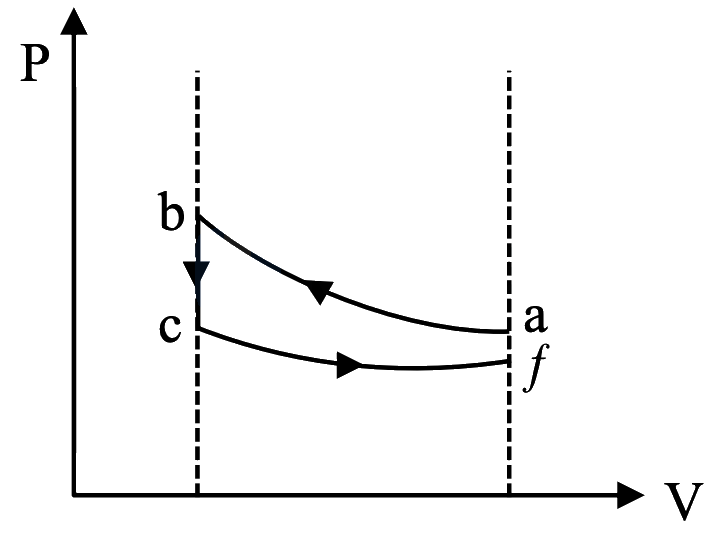
[Given: ]
Options
- AThe schematic P-V diagram of the processes described above is:
- BThe change in internal energy in going from state to is .
- CThe net change in the internal energy in the whole process is .
- DThe pressure and temperature of the state are times the atmospheric pressure and K, respectively.
Correct answer
A. The schematic P-V diagram of the processes described above is:
Step-by-step solution
For state : , , , .
For a monoatomic gas, and .
Process is a sudden compression, which is an adiabatic process.
Using :
Given , we get .
Using :
.
Thus, the pressure at state is times the atmospheric pressure. Option (D) is incorrect.
The change in internal energy for process is:
.
Option (B) is correct.
Process is isochoric (stationary piston), so .
The gas cools to the water bath temperature, .
Process is isothermal (slow expansion in water bath), so and .
The net change in internal energy for the entire process depends only on the initial and final temperatures:
.
Option (C) is correct.
For the P-V diagram:
Process is an adiabatic compression (curve upwards and to the left).
Process is an isochoric cooling (vertical line downwards).
Process is an isothermal expansion (curve downwards and to the right).
Comparing pressures at volume :
and
Since , point lies above point . The given schematic diagram correctly represents all these features. Option (A) is correct.
Answer: The schematic P-V diagram of the processes described above is:; The change in internal energy in going from state to is .; The net change in the internal energy in the whole process is .
For a monoatomic gas, and .
Process is a sudden compression, which is an adiabatic process.
Using :
Given , we get .
Using :
.
Thus, the pressure at state is times the atmospheric pressure. Option (D) is incorrect.
The change in internal energy for process is:
.
Option (B) is correct.
Process is isochoric (stationary piston), so .
The gas cools to the water bath temperature, .
Process is isothermal (slow expansion in water bath), so and .
The net change in internal energy for the entire process depends only on the initial and final temperatures:
.
Option (C) is correct.
For the P-V diagram:
Process is an adiabatic compression (curve upwards and to the left).
Process is an isochoric cooling (vertical line downwards).
Process is an isothermal expansion (curve downwards and to the right).
Comparing pressures at volume :
and
Since , point lies above point . The given schematic diagram correctly represents all these features. Option (A) is correct.
Answer: The schematic P-V diagram of the processes described above is: