
Concepts Of Physics MCQ Edition [Volume 1]
- Exam
- Concepts Of Physics MCQ Edition [Volume 1]
- Subject
- Physics
- Chapter
- Sound Waves
Concepts Of Physics MCQ Edition [Volume 1] · Physics · Sound Waves
Two coherent narrow slits emitting sound of wavelength λ in the...
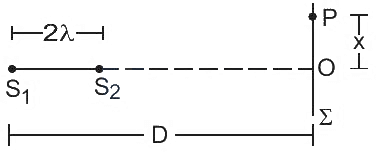
Two coherent narrow slits emitting sound of wavelength in the same phase are situated parallel to one another with a small separation of . The sound is detected by sliding a detector along the screen positioned at a distance from the slit , as depicted in the figure. Determine the distance such that the intensity at matches the intensity at .
Options
- A
- B
- C
- D
Correct answer
C.
Step-by-step solution
The path difference at point is given by:
Since the path difference is an integer multiple of the wavelength, constructive interference occurs at , resulting in maximum intensity.
For the intensity at point to match the intensity at , constructive interference must also occur at . The path difference at is:
As increases, the path difference decreases from towards . The next maximum intensity occurs when the path difference is . Thus, we set:
Let . The equation becomes:
Squaring both sides, we get:
Given that , we can approximate . Substituting back :
Squaring both sides:
Answer: