
Concepts Of Physics MCQ Edition [Volume 1]
- Exam
- Concepts Of Physics MCQ Edition [Volume 1]
- Subject
- Physics
- Chapter
- Some Mechanical Properties of Matter
Concepts Of Physics MCQ Edition [Volume 1] · Physics · Some Mechanical Properties of Matter
When a spherical ball is dropped into a long column of a viscous...
When a spherical ball is dropped into a long column of a viscous liquid, its speed as a function of time is best represented by the graph
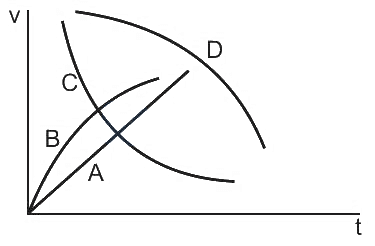
Options
- AA
- BC
- CB
- DD
Correct answer
C. B
Step-by-step solution
, the buoyant force acting upwards, and the viscous drag force acting upwards. The net downward force is given by:
According to Stokes' law, the viscous drag force is proportional to the velocity of the ball (). As the velocity of the ball increases, the viscous drag force also increases, which causes the net downward force and the acceleration to decrease.
Eventually, the viscous drag force becomes large enough such that the net force becomes zero. At this point, the acceleration is zero, and the ball continues to move with a constant maximum velocity called the terminal velocity ().
The velocity as a function of time is given by the relation:
This equation represents an exponentially increasing curve that starts from the origin and asymptotically approaches a constant value (). Graph B correctly represents this behavior.