
Concepts Of Physics MCQ Edition [Volume 2]
- Exam
- Concepts Of Physics MCQ Edition [Volume 2]
- Subject
- Physics
- Chapter
- Magnetic Field
Concepts Of Physics MCQ Edition [Volume 2] · Physics · Magnetic Field
Two metal strips, each of length l , are clamped parallel to one...
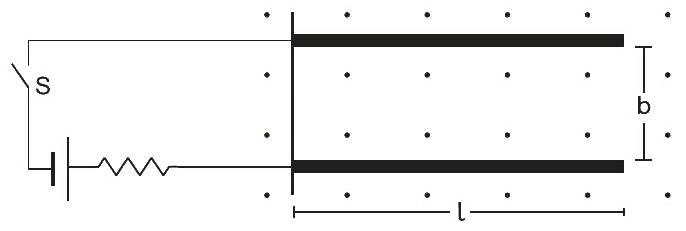
Two metal strips, each of length , are clamped parallel to one another on a horizontal floor with a separation between them. A wire of mass lies perpendicularly across them, as shown in the figure. A vertically upward magnetic field of strength is present in the space. The metal strips are smooth, whereas the coefficient of friction between the wire and the floor is . Once the switch is closed at the instant , a current is established. Determine how far away from the strips the wire will reach before coming to a halt.
Options
- A
- B
- C
- D
Correct answer
C.
Step-by-step solution
While the wire is on the metal strips, it experiences a magnetic force due to the current flowing through it. The magnitude of this magnetic force is given by:
Since the metal strips are smooth, there is no frictional force acting on the wire during this part of the motion. The work done by the magnetic force as the wire moves along the entire length of the strips is converted into its kinetic energy:
Let be the velocity of the wire just as it leaves the metal strips. Its kinetic energy is:
Once the wire leaves the strips, it moves on the horizontal floor where the magnetic force is no longer present (as the circuit is broken), but it experiences a kinetic frictional force. The frictional force is:
Let be the distance the wire travels on the floor before coming to a halt. The work done by friction will dissipate the entire kinetic energy of the wire. By the work-energy theorem:
Solving for , we get the distance the wire reaches away from the strips: