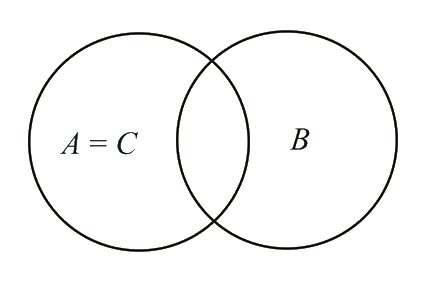
For A = C, A - C = ϕ<br/>⇒ ϕ ⊆ B<br/>ButA⊈B
Hence, If (A−C)⊆B, then A ⊆ Bisnottrue<br/>Letx \in C, ⇒ x \in (C∪A) \cap \left(C \cup B\right)<br/>⇒ x \in \left(C \cup A\right)andx∈(C∪B)
⇒(x∈C or x∈A)and(x∈Corx∈B)
⇒x∈C or x∈(A∩B)<br/>⇒ x \in C or x \in C\left(asA \cup B ⊆ C\right)<br/>⇒ x \in C<br/>⇒ \left(C \cup A\right) \cap \left(C \cup B\right) ⊆ C....(i)<br/>Nowx \in C ⇒ x \in \left(C \cup A\right)andx∈(C∪B)
⇒x∈(C∪A)∩(C∪B)<br/>⇒ C ⊆ ( C \cup A ) \cap \left(C \cup B\right).....(ii)<br/>⇒From(i)and(ii)<br/>C = \left(C \cup A\right) \cap \left(C \cup B\right)
Hence, (C∪A)∩(C∪B)=C is true
Let x∈A and x∈/B
⇒x∈(A−B)
⇒x∈C(asA−B⊆C)<br/>Letx \in Aandx \in B<br/>⇒ x \in \left(A \cap B\right)<br/>⇒ x \in C \left(asA \cap B ⊆ C\right)
Hence x∈A⇒x∈C
⇒A⊆C
Hence, If (A−B)⊆C, then A ⊆ Cistrue<br/>asC ⊇ \left(A \cap B\right)
⇒B∩C⊇(A∩B)
as A \cap B \ne ϕ<br/>⇒ B \cap C \ne ϕ<br/>Hence,B \cap C \ne ϕistrue</p><p>Alternatesolution</p><p>Given</p><p>ϕ \ne A \cap B ⊆ C</p><p>Letanswerthat</p><p>C = \left\{1, 2, 3, 4, 5, 6\right\}</p><p>A={1,2,3}
B={3,4,5}</p><p>A∩B={3}</p><p>Option(a)</p><p>B \cap C = \left\{3, 4, 5\right\} \ne ϕ</p><p>Option(b)C \cup A = \left\{1, 2, 3, 4, 5, 6\right\}
C∪B={1,2,3,4,5,6}
\left(C \cup A\right) \cap \left(C \cup B\right) = \left\{1, 2, 3, 4, 5, 6\right\} = C</p><p>Option(c)A−B={1,2,3} ⊆ CA ⊆ CTrue</p><p>Option(d)A−C=ϕ⊆BA⊆C Not correct
∴ Option (d) is correct
