Quantrex Quantrex AcademyJEE · NEET · NDA PYQs with solutions Open app
JEE Main 20137 April
Exam
JEE Main
Year
2013
Date
7 April
Subject
Physics
Chapter
Oscillations

JEE Main 2013 · 7 April · Physics · Oscillations

An ideal gas enclosed in a vertical cylindrical container supports...

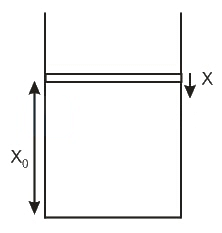
An ideal gas enclosed in a vertical cylindrical container supports a freely moving piston of mass M\text{M}. The piston and the cylinder have equal cross-sectional area A\text{A}. When the piston is in equilibrium, the volume of the gas is V0{V}_{0} and its pressure is M0{M}_{0}. The piston is slightly displaced from the equilibrium position and released. Assuming that the system is completely isolated from its surrounding, the piston executes a simple harmonic motion with frequency
[Assume the system is in space.]

An ideal gas enclosed in a vertical cylindrical container supports a freely moving piston of mass M . The piston and

Options

  1. A12πA2γP0MV0\dfrac{1}{2\pi}\sqrt{\dfrac{{\text{A}}^{2}\gamma{\text{P}}_{0}}{{\text{MV}}_{0}}}.
  2. B12πMV0AγP0\dfrac{1}{2\pi}\sqrt{\dfrac{{\text{MV}}_{0}}{\text{A}\gamma{\text{P}}_{0}}}.
  3. C12πAγP0V0M\dfrac{1}{2\pi}\dfrac{\text{A}\gamma{\text{P}}_{0}}{{\text{V}}_{0}\text{M}}
  4. D12πV0MP0A2γ\dfrac{1}{2\pi}\dfrac{{\text{V}}_{0}{\text{MP}}_{0}}{{\text{A}}^{2}\gamma}.

Correct answer

A. 12πA2γP0MV0\dfrac{1}{2\pi}\sqrt{\dfrac{{\text{A}}^{2}\gamma{\text{P}}_{0}}{{\text{MV}}_{0}}}.

Step-by-step solution

For an adiabatic process,

Pvγ=constant{\text{Pv}}^{\gamma} = \text{constant}

Differentiating with respect to vv,

dPdv(vγ)+Pγvγ−1=0\dfrac{\text{dP}}{\text{dv}}\left({\text{v}}^{\gamma}\right) + P\gamma{\text{v}}^{\gamma - 1} = 0

dP=−γPvdv=−γPvAdx\text{dP} = \dfrac{- \gamma P}{\text{v}}\text{dv} = \dfrac{- \gamma P}{\text{v}}\text{Adx}

An ideal gas enclosed in a vertical cylindrical container supports a freely moving piston of mass M . The piston and

Thus, the acceleration, a=dFM=γPA2MVdx\text{a} = \dfrac{\text{dF}}{\text{M}} = \dfrac{\gamma{\text{PA}}^{2}}{\text{MV}}\text{dx}

Comparing with , a=−ω2dx\text{a} = - {\omega}^{2}\text{dx}, we get,

ω=γP0A2MV0=2\pif\omega = \sqrt{\dfrac{\gamma{P}_{0}{A}^{2}}{M{V}_{0}}} = 2\pif

f=12πγP0A2MV0f = \dfrac{1}{2\pi}\sqrt{\dfrac{\gamma{P}_{0}{A}^{2}}{M{V}_{0}}}
Practice Oscillations on Quantrex Academy →

More from Oscillations

A tank contains two immiscible liquids of densities 6ρ and 2ρ . The higher density liquid… JEE Advanced 2026The frequency of oscillation of a mass m suspended by a spring is v_1 . If the length of… JEE Main 2026A spring stretches by 2 mm when it is loaded with a mass of 200 g. From equilibrium… JEE Main 2026A particle is executing simple harmonic motion. Its amplitude is A and time period is 5… JEE Main 2026Match List-I with List-II. List-I List-II A. ^2 ω t I. Periodic with time period T =… JEE Main 2026A uniform disc of radius R and mass M is free to oscillate about the axis A as shown in… JEE Main 2026The velocity of a particle executing simple harmonic motion along x -axis is described as… JEE Main 2026The equation of motion of a particle is given by x = a (50t + (π)/(3)) cm. The particle… JEE Main 2026 Full Oscillations list All JEE Main PYQs